
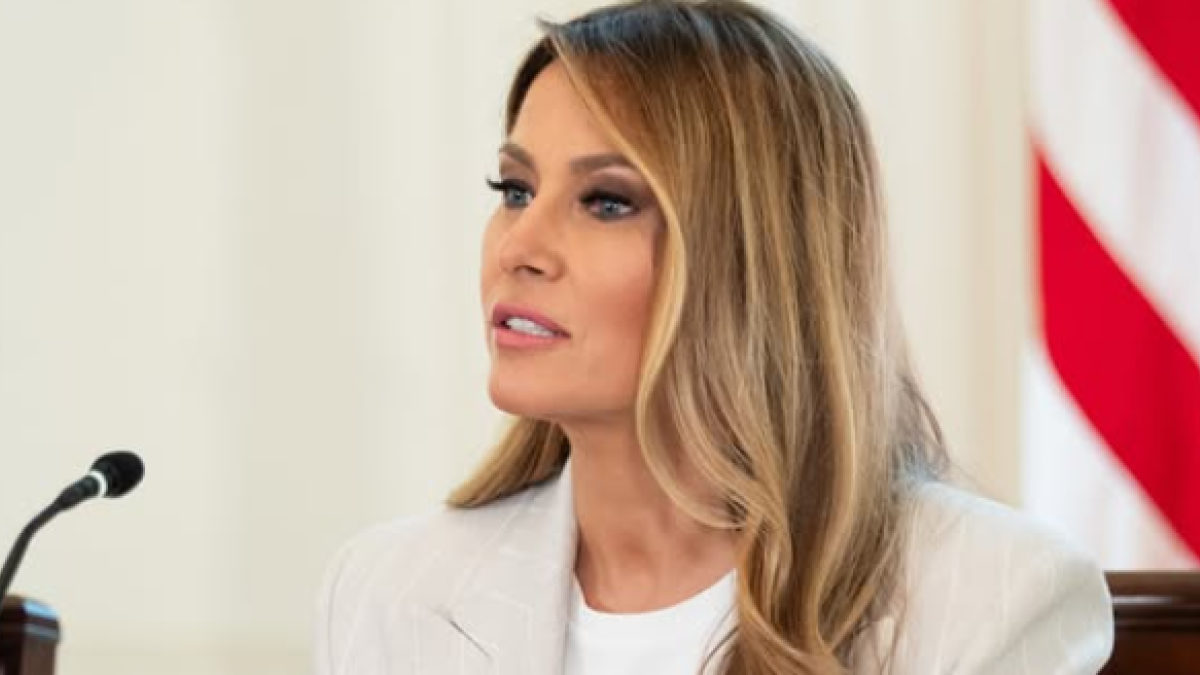
In a rare and highly direct public address, Melania Trump has spoken out to firmly deny any alleged connection to Jeffrey Epstein, pushing back against what she described as false, damaging, and politically motivated claims that have circulated for years. Speaking from the White House, Melania Trump did not hold back. She called the allegations “lies” and stated clearly that she has never had any relationship with Epstein or his associate Ghislaine Maxwell.
Her tone was not defensive in the traditional sense but assertive, as she positioned herself as someone being unfairly targeted by misinformation and opportunistic narratives.
She addressed several of the most widely discussed claims directly, including speculation that she had traveled on Epstein’s private plane or visited his island. According to her, both claims are completely false. She emphasized that she was never on his plane and never visited any of his properties, attempting to shut down what has become one of the most persistent threads in the broader Epstein-related discourse.
One of the more specific points she responded to was a reported email exchange with Ghislaine Maxwell from the early 2000s. Melania acknowledged that there had been a brief interaction but dismissed its significance, describing it as nothing more than a casual and polite reply that has since been exaggerated into something far more serious than it actually was. In her view, the attempt to use that exchange as evidence of any deeper connection is misleading at best.
At the center of her statement was a broader frustration with how narratives around Epstein continue to evolve and expand, often pulling in names and associations that may not hold up under scrutiny. She warned the public to be cautious about what they believe, particularly in an environment where manipulated images and unverified claims can spread rapidly across social media and digital platforms.
Her statement also took a turn toward advocacy, as she called on lawmakers to focus their attention on the victims of Epstein’s crimes rather than the surrounding speculation. She urged for public hearings that would give survivors the opportunity to testify and be heard, positioning this as the conversation that truly matters amid the noise.
The timing of her statement adds another layer of complexity. It comes at a moment when the Epstein case has once again entered public conversation, with renewed scrutiny around documents, associations, and institutional responses. At the same time, her husband, Donald Trump, has also been linked to discussions around the files, though he has denied prior knowledge of her planned remarks despite reports suggesting otherwise.
This has created a situation where personal defense, political positioning, and public accountability are all intersecting. The Epstein case has long existed at that intersection, where legal realities, public perception, and media narratives often blur into one another, making it difficult to separate fact from speculation for the average observer.
Melania Trump’s decision to speak publicly is notable in itself, as she has historically maintained a relatively low profile compared to other political figures in similar positions. When she does step forward, it tends to carry weight, not just because of her role, but because of how selectively she chooses those moments.
What this statement ultimately reflects is the ongoing impact of the Epstein scandal far beyond the individuals directly involved. Years after his death, the ripple effects continue to touch politics, media, and public discourse, drawing in figures from different worlds and forcing responses that might otherwise never have been made.
At the same time, it highlights the challenge of navigating reputation in the digital age. Allegations, whether verified or not, can take on a life of their own, shaping perceptions long before any formal conclusions are reached. For public figures, responding to those narratives becomes a delicate balance between defending oneself and not amplifying the claims further.
Melania Trump’s message was clear. She rejects the allegations, denies any meaningful association, and frames the entire situation as an attempt to damage her reputation. Whether that statement changes public perception is another question entirely, but it marks a definitive attempt to reclaim control over the narrative.
And in a situation as layered and sensitive as this one, control over the narrative may be just as important as the facts themselves.