
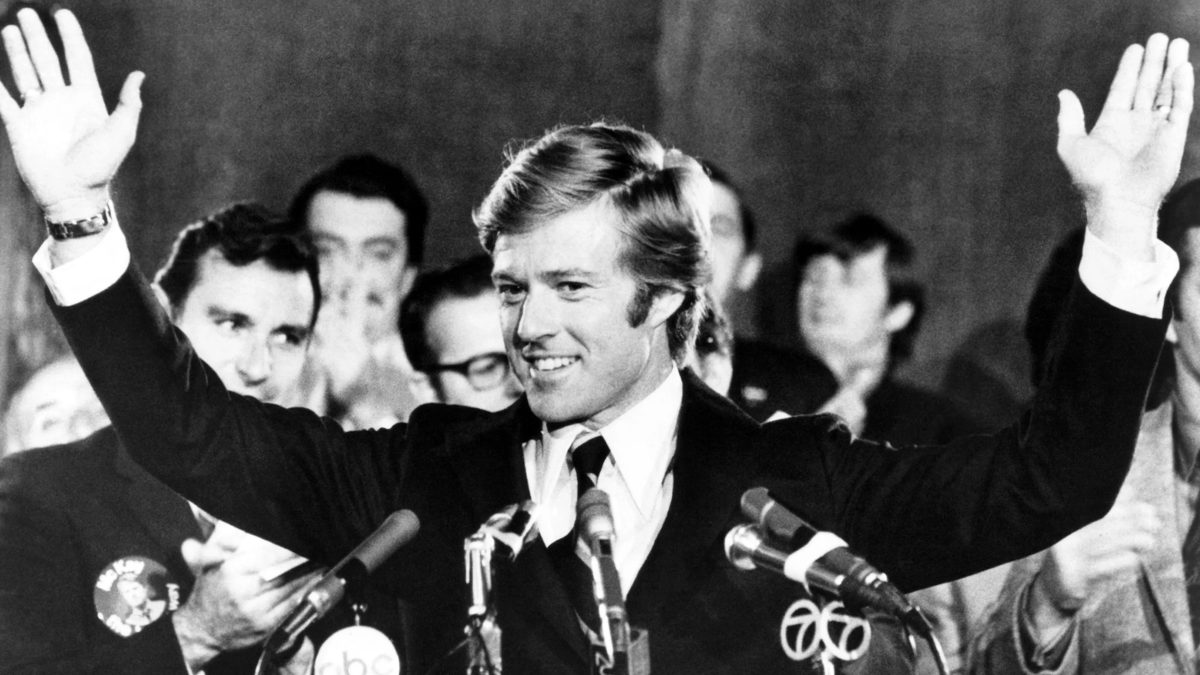
Jeremy Larner, the Oscar-winning screenwriter best known for the acclaimed 1972 political drama The Candidate, has died at the age of 88. Larner passed away on February 24 at a nursing facility in Oakland, California, following a period of illness. The news was confirmed to The Hollywood Reporter by his son, Jesse Larner.
Larner left behind a career that uniquely blended politics, journalism, and filmmaking. His most celebrated work, The Candidate, earned him the Academy Award for Best Original Screenplay in 1973. The film, produced by Warner Bros., became a defining political drama of its era and remains widely discussed for its sharp commentary on campaign culture and political ambition.
Directed by Michael Ritchie and starring Robert Redford, The Candidate follows Bill McKay, an idealistic lawyer who reluctantly agrees to run for the U.S. Senate despite believing he has little chance of winning. As the campaign progresses and public support unexpectedly grows, McKay ultimately wins the election. The film concludes with the now-famous line he asks his campaign manager after victory: “What do we do now?”
The screenplay’s authenticity came from Larner’s own experience in politics. Before entering the film industry, he worked as a speechwriter during the 1968 presidential campaign of Eugene McCarthy, the U.S. senator who ran as an anti–Vietnam War candidate. His firsthand exposure to political campaigning deeply influenced the tone and realism of The Candidate.
Reflecting on the film years later, Larner explained that his unusual background made him stand out among screenwriters. “One of the reasons they approached me was that I was one of the very few writers who had written speeches for a presidential campaign and was also a screenwriter,” he said.
Larner often described politics through the lens of performance. In his view, politicians shared similarities with movie stars, adopting larger-than-life versions of themselves for public audiences. He once remarked that a politician could “lose himself in a character,” becoming a symbolic figure representing ideals such as truth or beauty.
He also memorably compared the emotional experience of campaigning to a dangerous river journey. “A campaign was like drifting downriver on a raft,” he said. “Everything is beautiful. Then you begin to hear the roar of the falls up ahead—but it’s too late.”
Before writing The Candidate, Larner had already established himself as a novelist and journalist. His 1964 novel Drive, He Said was adapted into a 1971 film directed by Jack Nicholson in his feature directorial debut. Nicholson reportedly contacted Larner personally about the project, saying, “Jer, I’m gonna be a star, and they’re gonna let me direct a picture. I want you to come out and write it.”
Born on March 20, 1937, in Indianapolis, Larner attended Shortridge High School, where he won the city’s high school tennis championship. He later graduated from Brandeis University in 1958 before pursuing graduate studies at the University of California, Berkeley.
During the 1960s, he built a strong reputation as a freelance journalist. His writing appeared in major publications such as Life Magazine, The New Republic, and Harper’s Magazine. His work covered a wide range of subjects, including politics, social issues, and international events like the 1968 Mexico City Olympics.
Although Larner continued writing screenplays and essays throughout his career, he often spoke candidly about the limited influence writers held in Hollywood. He once noted that writers rarely had significant power in the film industry unless they reached the stature of celebrated screenwriters such as Paddy Chayefsky.
When accepting his Oscar in 1973, Larner acknowledged the political world that had inspired his storytelling. He remarked that as long as politicians continued to use lofty language about ideals such as “honor,” filmmakers would continue to produce even sharper and more insightful political dramas.
Larner’s legacy remains closely tied to The Candidate, a film that continues to resonate decades after its release for its insightful look at the mechanics and contradictions of political life.
He is survived by his sons, Jesse and Zachary, and his brother Daniel.