
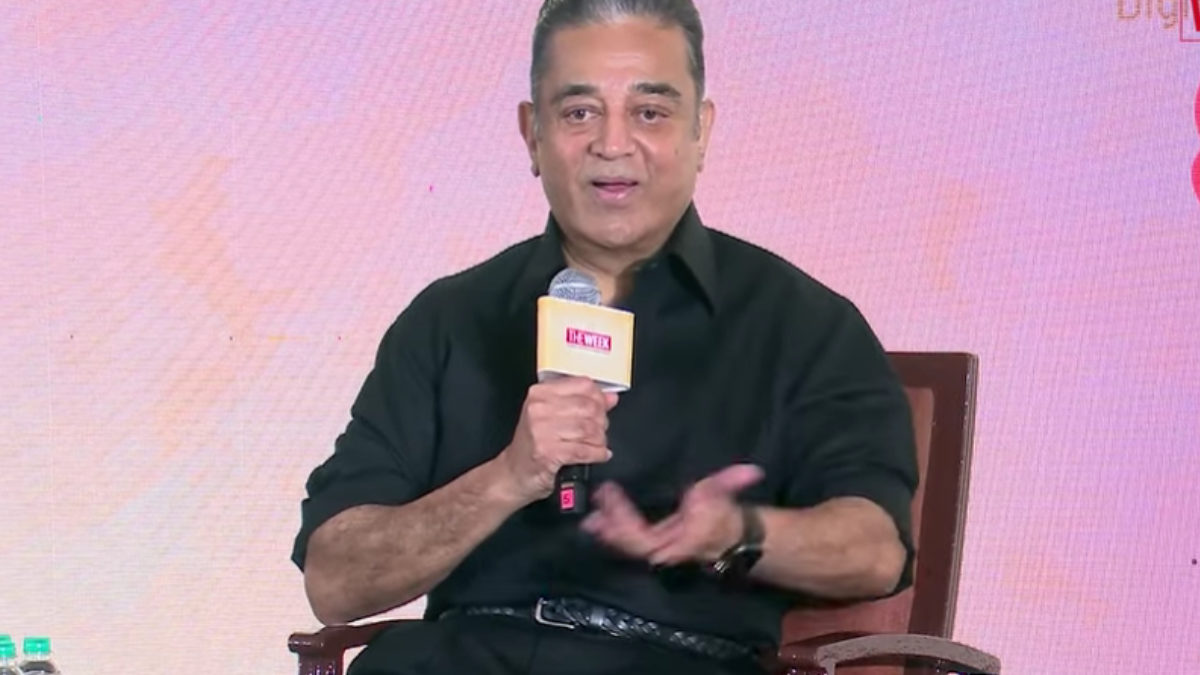
Veteran actor and filmmaker Kamal Haasan recently stirred an important conversation about the evolving definition of success in cinema. Speaking at a leadership summit in Tamil Nadu, the multi-hyphenate star candidly addressed what he sees as a worrying shift in the film industry — from valuing artistic excellence to prioritizing box office collections above all else. Known for his thought-provoking cinema and fearless experimentation, Kamal used the platform to express his discomfort with how creative merit is increasingly measured in monetary terms.
During his speech, Kamal Haasan reflected on how standards of evaluation have changed over time. Drawing a metaphor from academics, he remarked that while he once believed he had “made his mark” through the quality of his work, today’s system appears to judge success differently. According to him, the benchmark has shifted from content and craftsmanship to the number of crores a film earns. He pointed out that no one seems interested in examining the substance of his work anymore — whether it is the writing, the thematic depth, or the cinematic treatment. Instead, discussions are often reduced to box office figures and opening weekend collections. The veteran actor described this as a form of hegemony that pressures filmmakers to chase numbers rather than pursue artistic truth.
Kamal further elaborated on his philosophy of art, emphasizing that excellence, not revenue, is what truly motivates him. He stated that the purpose of his art is to challenge perspectives and evoke thought. In his words, meaningful cinema should make “uncomfortable people comfortable” and “very comfortable people very uncomfortable.” This layered statement reflects his long-standing commitment to socially conscious storytelling and narratives that question norms. Throughout his career, Kamal Haasan has been associated with films that push boundaries, tackle complex themes, and resist formulaic storytelling — often at the risk of commercial unpredictability.
His remarks come at a time when the Indian film industry is witnessing record-breaking box office numbers and pan-India blockbusters dominating conversations. While financial success undeniably plays a crucial role in sustaining the industry, Kamal’s comments highlight the tension between commerce and creativity — a debate that has persisted for decades but feels more intense in the era of social media metrics and weekend collection breakdowns.
On the professional front, Kamal Haasan was last seen in the lead role in Thug Life, directed by acclaimed filmmaker Mani Ratnam. The film revolves around Rangaraaya Sakthivel Naicker, a powerful gangster whose life takes a dramatic turn after a violent shootout leaves a rival dead and his children abandoned. Amid the turmoil, Sakthivel and his brother Manickam adopt a young boy named Amaran, whom Sakthivel raises as his own son. Years later, circumstances lead to Sakthivel’s imprisonment. Upon his release, he finds that his foster son has been elevated as the new head of the empire, sparking a deep emotional and power-driven conflict between the two. The intense rivalry between mentor and protégé forms the emotional core of the narrative.
Looking ahead, Kamal Haasan has an exciting slate of projects. He is set to headline a film tentatively titled KH237, directed by the action duo Anbarivu and written by Syam Pushkaran, with music composed by Jakes Bejoy. Although an official announcement is awaited, reports suggest that the project will commence after the Tamil Nadu Assembly elections conclude. In addition, fans are eagerly anticipating a potential on-screen reunion between Kamal Haasan and superstar Rajinikanth in a project tentatively titled KHxRK Reunion, reportedly to be directed by Nelson Dilipkumar.
As Kamal Haasan continues to balance cinema and public discourse, his recent remarks serve as a reminder that for some artists, success is not merely counted in crores — it is measured in impact, integrity, and the courage to stay true to one’s vision.