
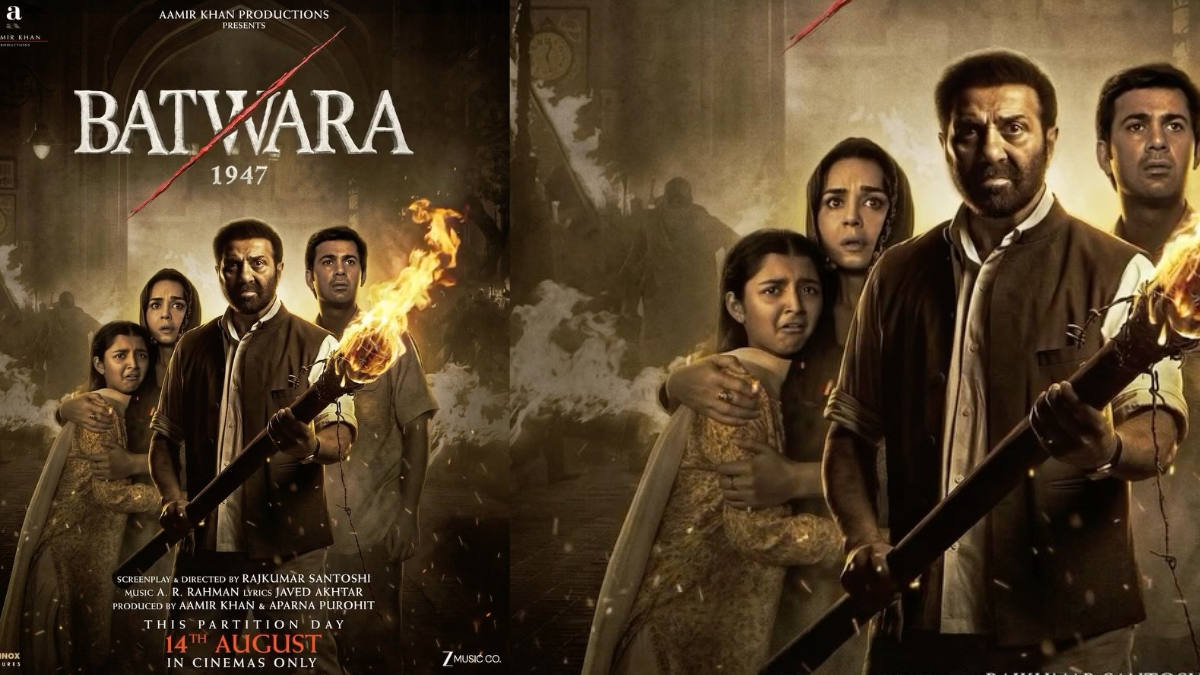
The first official motion poster of Batwara 1947, has been unveiled, giving audiences their first real glimpse into one of the most anticipated Hindi films of the year. Along with confirming the title change, the poster also announces the film’s theatrical release on August 14, 2026. The motion poster offers a brief but emotional look at the world of the film, featuring Sunny Deol and Preity Zinta in a story set against the backdrop of the Partition of India. While the visuals themselves are striking, one detail from the announcement stands out more than anything else.
Instead of marketing the release around Independence Day, the poster repeatedly highlights the phrase “This Partition Day.” It is an unusual choice for a film arriving during the August holiday period. Most films released around this time lean into the celebrations of August 15 and the patriotic sentiment associated with India’s independence. Batwara 1947 appears to be taking a different approach.
The film releases on August 14, a date that marks Pakistan’s Independence Day, and the promotional campaign seems to be deliberately drawing attention to Partition rather than independence. It is a subtle distinction, but an important one. The messaging suggests that the filmmakers want audiences to reflect on the human consequences of 1947, a year remembered not only for freedom from British rule but also for one of the largest and most traumatic migrations in modern history.
The title change from Lahore 1947 to Batwara 1947 strengthens that idea. While the original title placed emphasis on a specific city, the new title shifts focus toward the event itself. “Batwara,” meaning partition or division, immediately evokes the larger historical tragedy that affected millions of people across the subcontinent. Taken together, the title and release strategy indicate that the film is positioning itself as a story about the emotional and human realities of Partition rather than a conventional patriotic drama.
The film is based on Asghar Wajahat’s acclaimed play Jis Lahore Nai Vekhya O Jamya E Nai, first published in 1989. Widely regarded as one of the most important literary works on Partition, the story explores themes of displacement, identity, and coexistence in the aftermath of 1947. Rather than focusing on political leaders or battlefield conflicts, it tells a deeply personal story about ordinary people trying to rebuild their lives amid extraordinary circumstances.
Beyond the story itself, the project has generated considerable interest because of the team behind it. It is rare to see so many influential figures from Indian cinema come together for a single historical drama.
The film is produced by Aamir Khan Productions, with Aamir Khan backing the project at a time when large-scale historical narratives have become increasingly challenging to mount. Leading the cast is Sunny Deol, whose screen image has long been associated with stories of national significance and emotional conviction. Joining him is Preity Zinta, marking a notable reunion that many audiences will be eager to see on screen.
The film is written and directed by Rajkumar Santoshi, one of the most respected filmmakers in Hindi cinema. Santoshi has previously delivered some of Indian cinema’s most memorable dramas, often combining strong social themes with powerful emotional storytelling. His collaboration with Sunny Deol has also produced successful films in the past, making their reunion another major point of interest.
The musical team adds even more weight to the project. Academy Award winner A. R. Rahman is composing the soundtrack, while veteran lyricist Javed Akhtar is writing the songs. Both artists have played a defining role in shaping the sound of Indian cinema over the last several decades. Their involvement suggests that music could become an important emotional pillar of the film’s storytelling.
What makes this combination particularly fascinating is the subject they have chosen to tackle. Partition remains one of the most significant and emotionally charged events in Indian history. Nearly eight decades later, its impact continues to be felt through family memories, cultural identities, and stories passed down through generations. Bringing together a filmmaker like Rajkumar Santoshi, performers like Sunny Deol and Preity Zinta, and creative legends such as A. R. Rahman and Javed Akhtar under the banner of Aamir Khan Productions gives the project a scale and significance that extends beyond a typical film release.
The motion poster itself is captioned with the line, “In times of hatred and fear, he chose courage.” That message appears to reflect the broader themes at the heart of the story. While it is still too early to judge the film, the first glimpse suggests an emotional narrative rooted in humanity, resilience, and compassion during one of the darkest chapters of the subcontinent’s history.
With its powerful subject matter, acclaimed source material, and an exceptional creative team, Batwara 1947 is already shaping up to be one of the most closely watched releases of 2026. If the motion poster is any indication, the film is aiming to do more than revisit history. It wants audiences to remember the people who lived through it.