
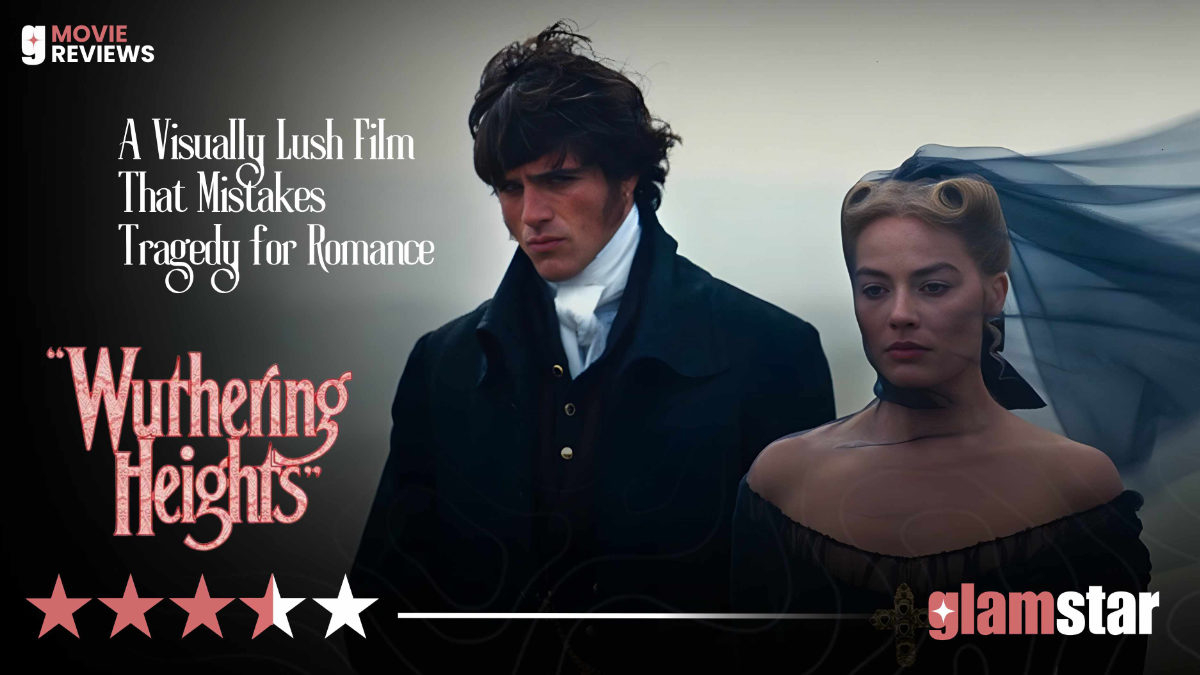
Emerald Fennell’s Wuthering Heights arrives with enormous expectations. Emily Brontë’s novel is not just a love story but a dark, violent, psychologically complex exploration of obsession, class, cruelty, and generational trauma. This new film, however, feels less like an adaptation and more like an entirely separate interpretation that borrows names and broad themes while reshaping the heart of the story into something far more romantic and visually driven.
The film opens with Mr. Earnshaw bringing home an abused boy and Catherine naming him Heathcliff. Their childhood bond is one of the strongest parts of the film. The younger actors portraying Cathy and Heathcliff are convincing, tender, and believable. Their dynamic carries emotional weight, and the early sequences capture the harshness of their upbringing, Earnshaw’s drinking, the violence in the household, and Heathcliff absorbing the worst of it to protect Cathy. These moments work. They feel raw and grounded.
As the characters age, the emotional clarity begins to weaken. Catherine and Heathcliff clearly love each other, yet much of the adult relationship feels built more on mood and imagery than on emotional depth. When Heathcliff leaves for five years to build wealth and returns, the film expects the audience to feel the magnitude of their longing, but it never fully earns that intensity. Margot Robbie and Jacob Elordi deliver competent performances, but the vulnerability and volatility that define Catherine and Heathcliff in the novel feel muted.
One of the most noticeable issues is the film’s focus on er*ticism and visual pleasure. Passion is heightened, and their relationship is portrayed through sensual imagery and overt physicality. In Brontë’s novel, their bond is not sentimental or overtly s*xual. It is destructive, obsessive, and tragic. Revenge and trauma drive Heathcliff far more than romance, and the consequences of their actions echo across generations. The film largely removes this dimension, presenting their love as intense but ultimately romanticized.
The narrative also makes significant structural changes. The entire second act of the novel, which explores the generational curse affecting Cathy Linton and Linton Heathcliff, is absent. Heathcliff’s revenge, which becomes darker and more obsessive after Catherine’s death in the book, is barely explored here. The story ends before the full weight of the tragedy can unfold, making the arc feel incomplete.
Several character portrayals are dramatically altered. Catherine herself is softened. In the novel she is cruel, immature, volatile, and often selfish, but here she appears more sympathetic and trapped by circumstance. Her physical portrayal is also different, with blonde hair instead of the long brown hair described in the text. Heathcliff’s racial identity, which in the novel is ambiguous but central to themes of prejudice and social exclusion, is largely removed, stripping away a major thematic layer involving classism, racism, and societal judgment.
Hindley Earnshaw, Catherine’s brother, plays a crucial role in the novel as Heathcliff’s abuser and later the man from whom Heathcliff seizes Wuthering Heights. In the film, Hindley has already died when the story begins, removing another key source of conflict and motivation. Nelly Dean undergoes perhaps the most drastic transformation. In the novel she is a servant and narrator, observing events more than shaping them. In the film she becomes a manipulative, central figure whose intentions feel far darker, altering the moral balance of the story.
The circumstances of Catherine’s death are also changed. In the film she dies following a miscarriage, whereas in the novel she dies after giving birth to her daughter Catherine Linton. This shift removes the continuation of the family line that drives the later half of Brontë’s narrative.
There are also smaller but telling changes. In the film, Catherine and Heathcliff engage in a full affair, including hidden meetings and kisses, while in the novel their reconnection is more restrained and tragic, defined by missed opportunities rather than scandal. These differences may seem subtle but they fundamentally reshape the tone of the story.
The production itself raises questions. With a reported budget of around $8 crore USD and distribution by Warner Bros. Pictures, the film does not always look as lavish as expected. The costumes, particularly Catherine’s wedding attire, feel underwhelming, lacking the grandeur or symbolism that should accompany such a pivotal moment. Many scenes rely heavily on silence, slow cinematography, and atmospheric shots, but the emotional core sometimes feels hollow.
One of the most powerful moments retained from the spirit of the novel comes near Catherine’s death, when Heathcliff begs her spirit to haunt him. In the original text, he cries, “Be with me always, take any form.. drive me mad! Only do not leave me in this abyss, where I cannot find you.” That line captures the madness, grief, and desperation that define their relationship, and it is this intensity that the film only occasionally reaches but Jacob Elordi delivered this dialogue with much sincerity and his accent for the entirety of the film was spot on.
Despite these criticisms, the film is not without merit. The childhood performances are excellent, the cinematography is often beautiful, and as a standalone romantic drama it can be engaging. But it works best when viewed not as an adaptation of Wuthering Heights but as an independent interpretation loosely inspired by it. The marketing, which framed it as a retelling of one of the greatest romances of all time, reveals a fundamental misunderstanding of the source material. Anyone who has read Brontë knows it is not a romance in the conventional sense. It is a story of obsession, cruelty, and the long shadow of trauma.
Having read the book, watched other interpretations of the story, and now seen this version as well, I feel my perspective is shaped by those comparisons. Taken independently, the film is not bad at all, and there are moments that work, but when placed alongside the richness of the source material and earlier adaptations, it feels like something is missing. The emotional and thematic depth that made the story so powerful on the page doesn’t fully translate here, which is perhaps why my review leans more critical than it might have if I were judging the film in isolation.
Adaptations do not need to be identical to their source, and interpretation is part of art. Actors and directors are entitled to their own perspectives. But when a film uses a literary classic as a promotional anchor, audiences naturally expect some fidelity to its themes and emotional truth. Here, the deviations are so extensive that the connection sometimes feels superficial.
Overall, Wuthering Heights (2026) is an enjoyable film if judged on its own terms, but as an adaptation it feels incomplete and emotionally diluted.
Movie: Wuthering Heights
Director: Emerald Fennell
Cast: Jacob Elordi as Heathcliff, Margot Robbie as Catherine Earnshaw, Alison Oliver as Isabella Linton, Owen Cooper as young Heathcliff, Hong Chau as Nellie Dean, Martin Clunes as Earnshaw
Run Time: 2 hours 16 minutes
Wuthering Heights
3.5