
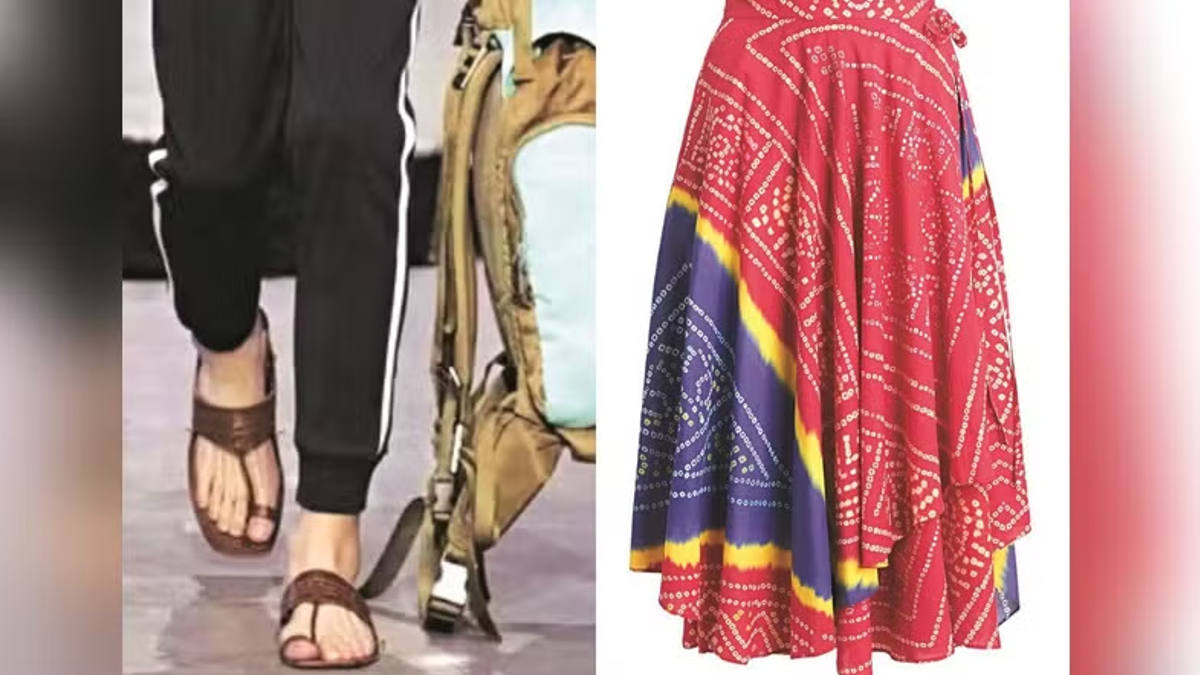
Ralph Lauren has once again found itself at the center of a cultural debate in India, this time over a Bandhani-inspired skirt that has sparked widespread backlash online. The controversy revolves around a cotton wrap skirt listed under the brand’s Polo line, priced at approximately ₹44,800, and described simply as a “Print Cotton Wrap Skirt” with tie dye motifs. At first glance, the issue may appear to be just another case of luxury pricing. However, the conversation quickly shifted beyond cost and into questions of cultural acknowledgment.
The skirt’s design closely resembles Bandhani, a centuries old tie dye technique originating from Rajasthan and Gujarat, known for its intricate patterns created by manually tying thousands of tiny knots before dyeing the fabric.
While the product description does include a reference to “Bandhani tie dye techniques,” critics argue that the acknowledgment is subtle and not clearly positioned as a central part of the product’s identity. It does not explicitly highlight India as the origin or recognize the artisan communities behind the craft. This omission has become the core of the backlash, with many questioning whether a passing reference is enough when the visual identity of the garment is so deeply rooted in a specific cultural tradition.
The debate intensified further because of how the garment appears to have been produced. Observers pointed out that the skirt uses printed patterns rather than the traditional hand tied dyeing method that defines authentic Bandhani. This raises concerns not only about attribution but also about the transformation of a labor intensive craft into a simplified, mass produced aesthetic for luxury consumption.
This is not the first time Ralph Lauren has faced criticism of this kind. Earlier in 2026, the brand drew backlash for featuring earrings resembling traditional South Asian jhumkas in its Paris Fashion Week collection, without clearly acknowledging their cultural origin. The repetition of such incidents has led to growing scrutiny over how global fashion houses engage with non Western design traditions.
The Bandhani skirt controversy has also reignited a broader conversation about the line between inspiration and appropriation. In global fashion, drawing from different cultures is not new. However, the expectation from audiences today has evolved. Consumers are increasingly asking for transparency, proper credit, and meaningful engagement with the communities whose crafts inspire these designs.
What makes this situation more complex is the lack of strong legal protection for traditional crafts. Many forms of cultural expression, including Bandhani, exist in a grey area where they are widely recognized but not formally protected under intellectual property frameworks. This leaves room for global brands to reinterpret these designs without necessarily being required to credit their origins, placing the responsibility largely in the realm of ethics rather than law.
Ultimately, the Ralph Lauren Bandhani episode is not just about one skirt. It reflects a growing tension between heritage and high fashion, where traditional crafts continue to influence global design but often without equal recognition for their origins. It also shows how quickly audiences today can call out perceived imbalances, pushing brands to rethink not just what they create, but how they communicate it.
The larger question remains unresolved. In a world where inspiration travels freely across borders, should acknowledgment be optional, or should it be an essential part of the story from the very beginning.
What makes these moments stand out is the contrast in how credit is treated. Global fashion often insists on recognition and originality within its own systems, yet when it draws from Indian and South Asian crafts, attribution becomes less direct. Bandhani is not just a visual motif. It is a technique built over generations by Rajasthani and Gujarati artisans. When such work is reinterpreted, renamed, and sold at a luxury price point without clearly centering its origins, the imbalance becomes hard to ignore. The design travels globally, but the credit often does not follow with the same visibility.