
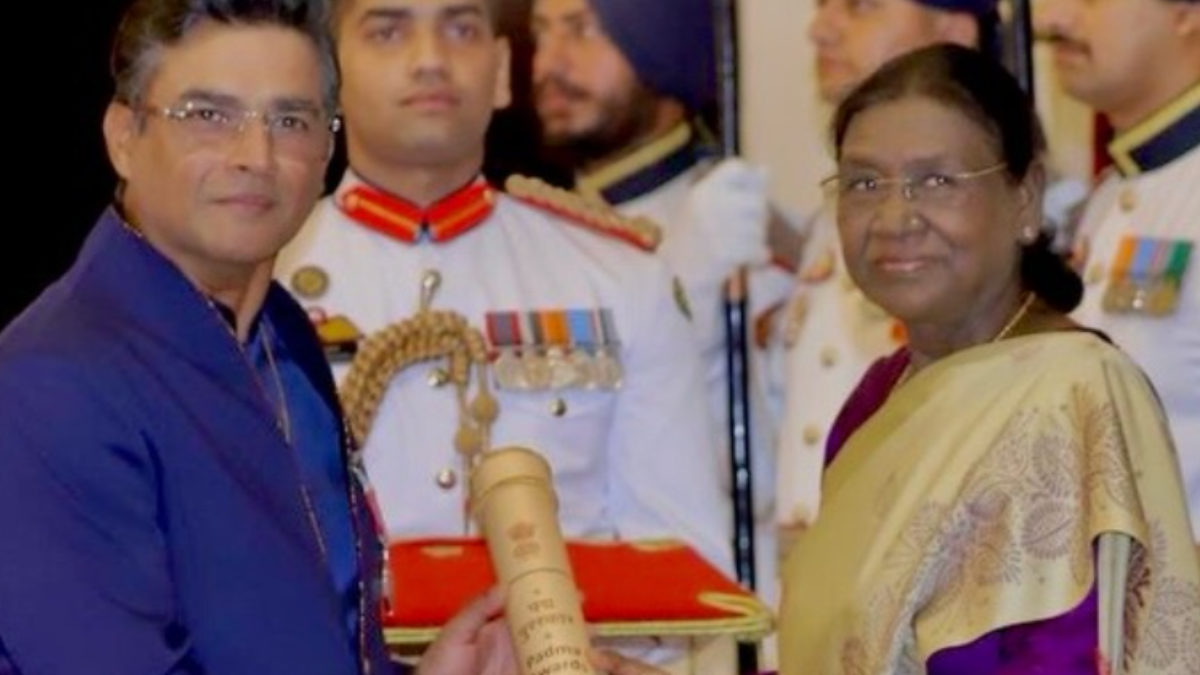
When the Government of India confers a Padma Shri upon an artist, it is not merely rewarding a successful career. It is acknowledging a body of work that has enriched the cultural fabric of the nation. The Padma Shri, India’s fourth highest civilian award, recognizes distinguished service and exceptional contribution in various fields, including the arts. In 2026, that honour was bestowed upon R. Madhavan, a performer whose journey has been defined not by stardom alone, but by consistency, dignity, reinvention, and an unwavering commitment to his craft.
For millions of fans across India, Madhavan’s Padma Shri feels less like a surprise and more like a long overdue acknowledgement. Few actors have managed to remain relevant, respected, and loved across multiple generations, languages, and film industries the way he has.
The remarkable thing about Madhavan’s career is that it never followed the conventional path of a superstar. He was never the loudest actor in the room. He never relied on larger than life heroism. Instead, he built his reputation through sincerity. Audiences connected with him because he felt real. Whether he was playing a romantic lead, a conflicted husband, a friend, a coach, a scientist, or an antagonist, there was always a sense of authenticity in his performances.
His breakthrough arrived with Mani Ratnam’s acclaimed Tamil film Alaipayuthey. The film transformed him into an overnight sensation and introduced audiences to an actor who could communicate emotions with remarkable ease. Soon after came Minnale, another defining success that cemented his image as one of the most charming romantic heroes of his generation.
For Hindi audiences, however, Madhavan became immortal through Rehnaa Hai Terre Dil Mein. Interestingly, the film was not a major box office success upon release. Yet over the years it evolved into a cult classic. The character of Maddy became so iconic that even today many fans refer to Madhavan simply as “Maddy.” Very few actors can claim ownership of a character that remains culturally relevant more than two decades later.
What truly separates Madhavan from many of his contemporaries is his refusal to be trapped within a single image. At a time when romantic heroes often struggled to reinvent themselves, he constantly challenged audience expectations.
In Kannathil Muthamittal and Anbe Sivam, he proved that he could handle emotionally layered and socially relevant narratives. The latter, particularly alongside Kamal Haasan, remains one of the most celebrated films in Tamil cinema and is frequently discussed for its humanistic philosophy and emotional depth.
Then came a series of Hindi films that showcased his versatility to a national audience. In Rang De Basanti, he left an impact despite limited screen time. In Guru, he stood confidently within a stellar ensemble cast. And in 3 Idiots, he became part of one of the most influential Indian films ever made. Even among giants like Aamir Khan, Madhavan’s portrayal of Farhan Qureshi resonated deeply with audiences who saw their own dreams and struggles reflected in the character.
Many actors would have comfortably continued repeating successful formulas after such achievements. Madhavan chose a different route. He embraced risk.
His performance in Tanu Weds Manu and later Tanu Weds Manu Returns demonstrated impeccable comic timing and maturity. Instead of dominating the screen, he allowed relationships and characters to breathe naturally, making the films relatable and memorable.
Then came perhaps one of the most transformative performances of his career in Irudhi Suttru, known in Hindi as Saala Khadoos. Gone was the charming romantic hero. In his place stood a rugged, emotionally scarred boxing coach. The physical transformation and emotional intensity of the role earned widespread acclaim and reminded everyone that Madhavan was far more than a crowd pleasing star. He was an actor willing to disappear into a character.
A year later, Vikram Vedha elevated his standing even further. His performance showcased restraint, intelligence, and depth. The film became a benchmark for modern Indian thrillers and remains one of the finest examples of contemporary storytelling.
Yet the defining chapter of Madhavan’s career may well be Rocketry: The Nambi Effect. As actor, writer, producer, and director, he took on the responsibility of bringing the life of scientist Nambi Narayanan to the screen. The project was ambitious, challenging, and deeply personal. It reflected not only his talent as a performer but also his courage as a storyteller. The film earned widespread appreciation and later won the National Award for Best Feature Film, becoming one of the proudest achievements of his career.
Beyond cinema, Madhavan has cultivated an image that is increasingly rare in the entertainment industry. He has maintained a reputation for humility, intelligence, discipline, and grace. He has represented India internationally, supported various social causes, and consistently carried himself with dignity. Even his personal life and his encouragement of his son Vedant’s sporting achievements have reinforced the image of a grounded individual who values effort over publicity.
That is perhaps why the Padma Shri feels so appropriate.
This honour is not merely for the romantic hero of the early 2000s. It is not just for the actor of 3 Idiots, Vikram Vedha, or Rocketry. It is for an artist who spent more than two decades proving that success and substance can coexist. It is for someone who crossed linguistic barriers between Tamil and Hindi cinema without losing his identity. It is for an actor who never chased trends but instead focused on meaningful work.
When R. Madhavan bowed respectfully after receiving the Padma Shri from President Droupadi Murmu, fans across the country saw more than an award ceremony. They saw the culmination of a journey built on talent, perseverance, humility, and excellence. It was a moment that celebrated not just an actor, but a man who has become one of the most respected faces of Indian cinema.
Some stars shine brightly for a few years. Some actors deliver a handful of memorable performances.
R. Madhavan belongs to a rarer category.
He has spent decades earning admiration one role at a time, one performance at a time, and now, one of India’s highest civilian honours stands as a testament to that extraordinary journey.