
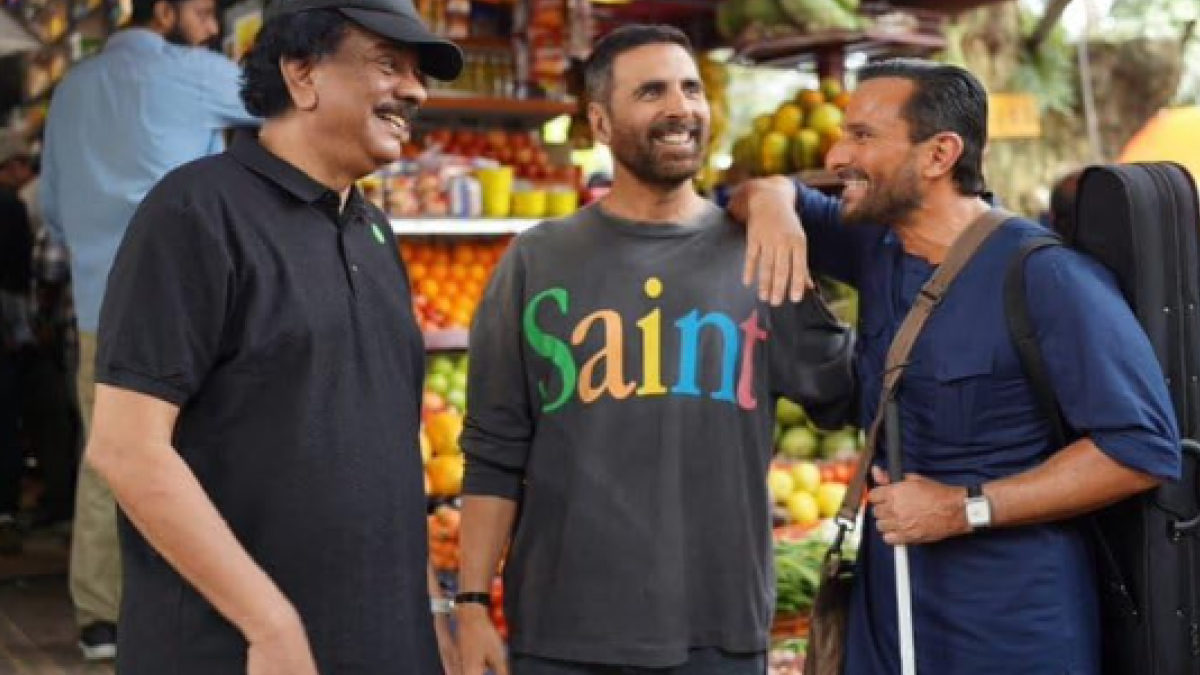
There is something unusually exciting about Akshay Kumar and Saif Ali Khan coming together again, but the real reason fans have started looking at Haiwaan with greater curiosity may have less to do with the 18 year gap and much more to do with the man directing them. Priyadarshan is bringing the two actors together again, and that changes the equation considerably.
Akshay and Saif first shared the screen in 1994 with Yeh Dillagi, before returning in the same year with Main Khiladi Tu Anari. The latter became the film that truly etched their pairing into popular memory. The combination worked because the two actors brought contrasting energies to the screen. Akshay was the action hero with comic timing and swagger, while Saif was the younger, more urbane presence. Their chemistry was effortless and, importantly, commercially proven.
They went on to work together through the 1990s in films including Tu Chor Main Sipahi and Keemat, before their first major reunion in a decade came with Tashan in 2008. On paper, everything seemed right. Akshay and Saif were back together, Kareena Kapoor was part of the cast and the film came with a stylish action image. Yet Tashan did not deliver commercially. For all its recall today, it remains a reminder that simply putting two familiar stars together does not guarantee the old magic.
There is another reason why Haiwaan feels different. The Saif Ali Khan who returns this time is not the Saif who walked into Main Khiladi Tu Anari. Somewhere along the way, Saif made one of the more interesting transformations in mainstream Hindi cinema. The romantic hero image that defined much of his early career was challenged decisively by Langda Tyagi in Omkara. The performance showed audiences an entirely different Saif, one who could be vicious, manipulative and deeply unsettling.
That transformation matters because Haiwaan is not asking Saif to go back to being the actor fans remember from the 1990s. It is bringing back an actor who has spent the intervening years expanding his range. Opposite him is an Akshay Kumar who too has travelled a long distance from the carefree action hero of the 1990s. The most intriguing part is that Akshay himself is stepping into an unusually dark space, playing an out-and-out villain.
So when the two meet in Haiwaan, the attraction is not simply nostalgia. It is the possibility of watching two actors who once worked together as young stars now bring decades of experience to a completely different relationship on screen. And then there is Priyadarshan.
For fans of the trio, this is where Haiwaan gets genuinely interesting. Priyadarshan and Akshay Kumar have already created a remarkably successful cinematic association, particularly through films such as Hera Pheri, Garam Masala, Bhool Bhulaiyaa and Bhool Bhulaiyaa 2. Their collaborations have demonstrated that Priyadarshan understands how to extract both the comic instinct and the dramatic vulnerability from Akshay. But bringing Saif into that equation adds another layer.
Priyadarshan has worked with Saif before too, most notably in the 2000 film Yeh Hai Mumbai Meri Jaan, but Haiwaan belongs to a very different phase of all three careers. The director is no longer simply bringing together two young stars. He is working with actors whose screen personalities have acquired considerably more depth, baggage and recognition.
That is perhaps why the Akshay-Saif-Priyadarshan combination has the potential to become the biggest talking point around Haiwaan. Akshay and Saif bring the nostalgia. Priyadarshan brings the credibility of knowing how to turn an unusual combination of actors into popular entertainment.
The biggest challenge, however, will be managing expectations. Main Khiladi Tu Anari remains the emotional benchmark for this pairing, and Haiwaan cannot realistically recreate 1994. Tashan already demonstrated the danger of assuming that nostalgia alone is enough. This time, the film needs to offer something new while allowing fans to enjoy the memory of what came before.
That is why the film’s darker premise could actually work in its favour. Instead of trying to recreate the buddy chemistry of Main Khiladi Tu Anari, Haiwaan appears to be taking two actors with a shared history and placing them on opposite sides of a much more intense conflict.
There is a wonderful symmetry to it. The Khiladi and the Anari are back, but neither is the Khiladi or the Anari anymore.
Akshay is no longer merely the action hero audiences grew up watching, while Saif is certainly no longer restricted to the romantic hero image with which he began his career. And behind them is Priyadarshan, a filmmaker whose association with Akshay alone carries enormous audience recall.
For fans, therefore, Haiwaan represents three reunions at once. Akshay and Saif are reuniting after 18 years. Saif is stepping into another challenging space after having reinvented himself as an actor. And Priyadarshan is once again directing Akshay, while bringing Saif into a combination that has never before been explored in this form.
Perhaps that is the real reason to be excited. Haiwaan does not have to become another Main Khiladi Tu Anari. It has to become the film that proves that after more than three decades, the Khiladi and the Anari can still surprise their audience.