
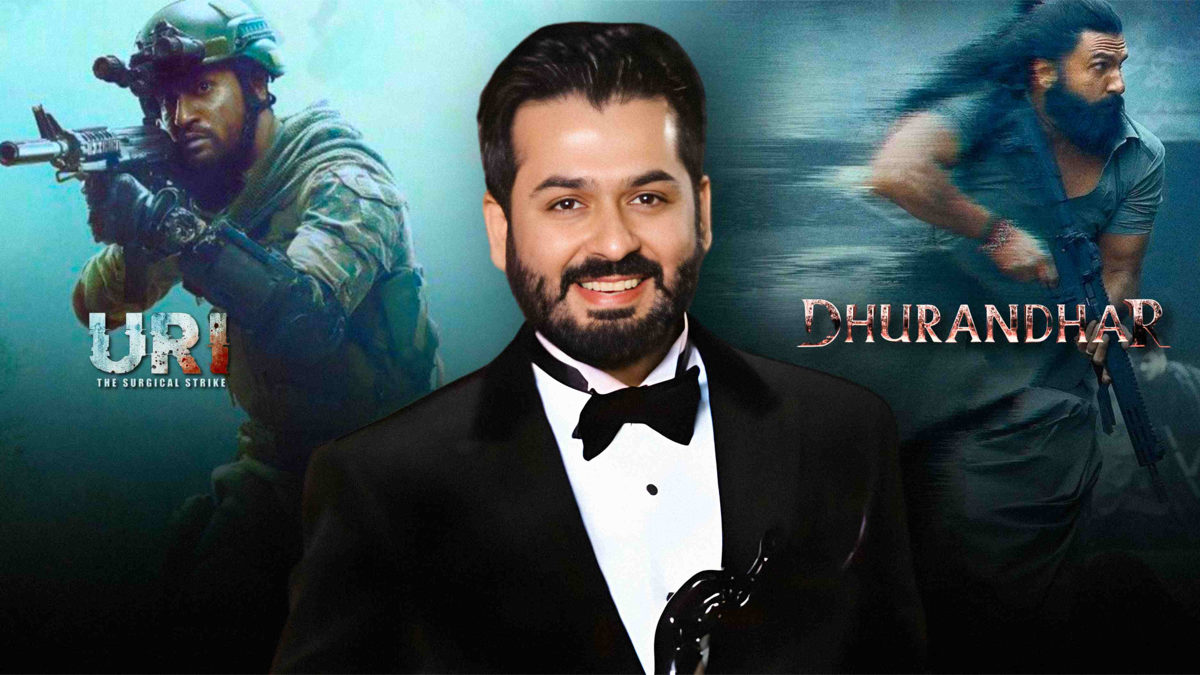
In the Hindi film industry, success stories are often told in hindsight as neat, linear journeys. Reality is rarely that tidy. Before Aditya Dhar became the filmmaker behind the blockbuster military drama Uri: The Surgical Strike and the sprawling espionage spectacle Dhurandhar, he spent nearly a decade navigating Bollywood’s most uncertain territory — development hell. Scripts collapsed. Directorial opportunities disappeared. Films were announced and quietly abandoned.
Ironically, the geopolitical event that killed one of his earliest directing opportunities later inspire the film that launched his career! That twist of fate now reads like the first act of a screenplay.
Aditya Dhar: A Delhi Boy Who Chose Storytelling
Born in New Delhi in 1983 into a Kashmiri Pandit family, Aditya grew up in an environment far removed from the film industry. His mother served as a dean at Delhi University, and academics were central to family life. But while studying at Delhi University, Dhar found himself increasingly drawn to theatre and performance. He spent years working with Delhi Music Theatre, gaining early exposure to narrative construction, character dynamics and stagecraft — experiences that would later influence his screenwriting style.
Before entering cinema, he also worked as a radio jockey (RJ), learning the rhythm of storytelling and the importance of audience engagement. The path to Bollywood, however, was anything but immediate.
Aditya Dhar’s Long Apprenticeship
Aditya Dhar’s entry into Hindi cinema came through writing. In the mid-2000s he began working as a lyricist, contributing to films such as Kabul Express and later projects like Haal-e-Dil and Daddy Cool. He eventually transitioned into screenwriting and dialogue work on films including Aakrosh and Tezz.
For nearly a decade, Aditya remained in the background — learning the mechanics of the industry from writers’ rooms and production corridors. These years were less visible but crucial. They shaped his instinct for tightly structured narratives and his interest in stories rooted in contemporary politics and national security.
Aditya Dhar’s Film That Never Happened
By the mid-2010s, Aditya Dhar was finally preparing to direct his first film. The project, reportedly backed by Dharma Productions (no less), was set to star Fawad Khan and Katrina Kaif. For a first-time filmmaker, it was the kind of launch that could change everything. Then politics intervened.
Following the 2016 Uri terror attack and the resulting backlash against Pakistani actors in Indian cinema, the project collapsed before it could begin production. Years of preparation vanished overnight.
Yet the same event that ended that film planted the seed for another. Instead of walking away from the story space, Aditya began developing a script inspired by India’s military response to the Uri attack itself. That script that become Uri: The Surgical Strike.
URI: The Film That Changed Everything
Released in 2019, Uri: The Surgical Strike marked Dhar’s directorial debut — and immediately altered the trajectory of his career. Featuring Vicky Kaushal alongside (his now wife) Yami Gautam and Paresh Rawal, the film dramatized India’s surgical strike operation with an unusual blend of tactical realism and cinematic momentum. Audiences responded instantly.
The film emerged as one of the biggest Hindi hits of 2019 and introduced a new grammar for mainstream military thrillers — grounded, research-driven and emotionally resonant. Aditya Dhar’s debut earned him the National Film Award for Best Director, an extraordinary recognition for a filmmaker making his first feature.
Suddenly, the industry had a new action voice.
Ashwatthama: The Ambitious Franchise That Stalled
After Uri, Dhar began developing what was intended to be one of the most ambitious mythological action projects attempted in Hindi cinema — The Immortal Ashwatthama.
The film, again featuring Vicky Kaushal, was envisioned as a large-scale trilogy blending Indian mythology with contemporary superhero storytelling. But the project became a casualty of the pandemic era. Escalating budgets and shifting industry economics eventually forced the film to be shelved.
For many directors, such a setback could have stalled momentum. Instead, Aditya Dhar began building something more sustainable.
B62: Building a Studio Ecosystem
Together with his brother Lokesh Dhar — a former executive at UTV Motion Pictures and Fox Star Studios — Dhar launched B62 Studios. The banner allowed him to develop projects rooted in political and historical themes without relying entirely on external studio decisions.
One of the company’s early productions, Article 370, explored the political and constitutional shifts surrounding Jammu and Kashmir and reinforced Dhar’s growing reputation for narratives drawn from real geopolitical developments.
But his next move would take that storytelling to a much larger scale.
Enter Dhurandhar
With Dhurandhar, Dhar expanded his canvas from military drama to full-scale espionage thriller. The film featuring Ranveer Singh alongside an ensemble that includes R Madhavan, Sanjay Dutt and Arjun Rampal.
Unlike Uri, which focused on a single military operation, Dhurandhar explores a broader web of covert missions, criminal networks and geopolitical manoeuvring. The scale signalled a new phase for Dhar — not just as a filmmaker but as a franchise builder.
The Next Chapter: Dhurandhar: The Revenge
That expansion continues with Dhurandhar: The Revenge, the sequel that pushes the narrative deeper into the world of espionage and retaliation.
For the trade, the film represents more than another action spectacle. It marks the consolidation of a filmmaker who has gradually moved from writing lyrics and dialogue to orchestrating large-scale cinematic universes.
The Pattern Behind the Films
Looking across his career, Aditya Dhar’s trajectory reveals a few defining patterns.
- He writes most of his own scripts.
- He builds narratives around contemporary geopolitical realities.
- And he moves deliberately, taking time between projects rather than chasing rapid output.
In an industry often driven by speed, Dhar’s rise has been patient and strategic.
From a writer navigating Bollywood’s lower rungs to a director commanding some of its most ambitious action productions, the journey has taken nearly two decades. The spectacle may unfold on screen.
But the real story of Aditya Dhar is the long road it took to reach that moment — and the possibility that his biggest chapter may still lie ahead.