
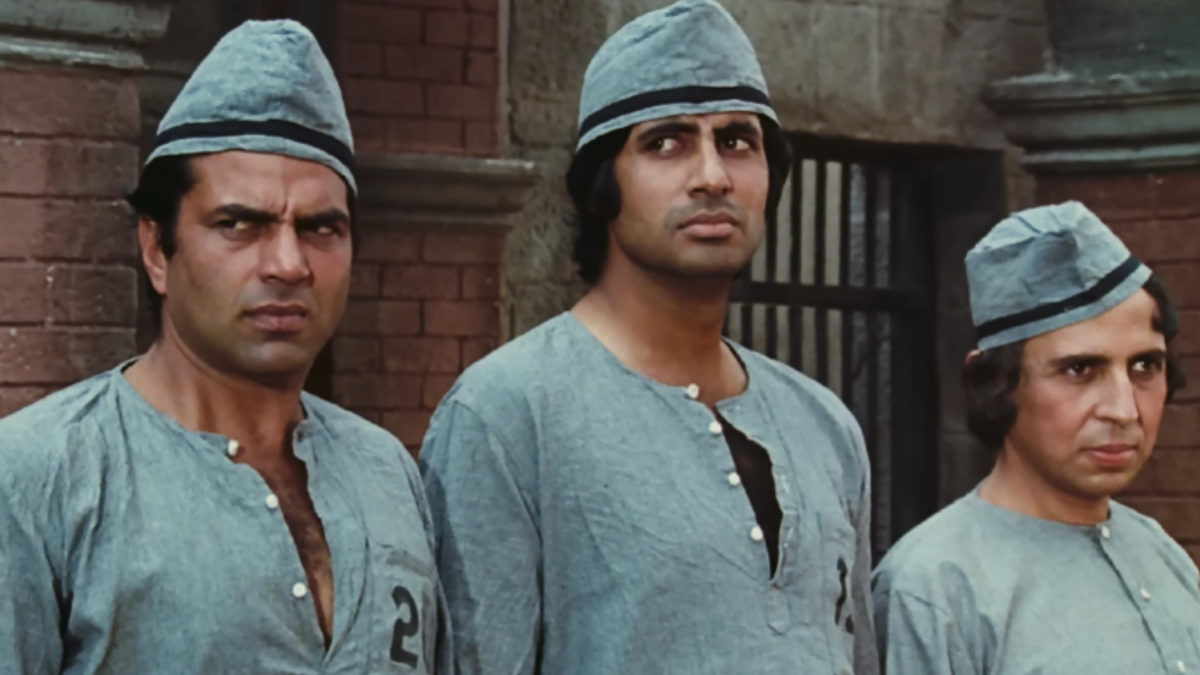
There are films that release, films that succeed, and films that echo. And then there is Sholay—a movie that somehow refuses to sit quietly in history, constantly resurfacing in memory like an old, familiar song. As the classic prepares for its grand 50-year return in a restored 4K avatar, it brings with it not just a film, but a treasure chest of stories—warm, absurd, funny, romantic, and occasionally unbelievable. Stories that remind us why Sholay isn’t just India’s biggest cult classic, but also its most human one.
Take, for instance, the delicious irony that Amjad Khan—the man whose voice would terrorise generations—was almost rejected for sounding “too soft.” The casting notes suggested looking elsewhere. But Salim–Javed saw something electric behind that gentle tone—a spark in his eyes that could burn down the screen. They were right. The nation eventually discovered its most iconic villain, one chilling pause at a time.
The set itself was a theatre of drama. Dharmendra, hopelessly besotted with Hema Malini, reportedly bribed the light boys to “accidentally” mess up shots so retakes could bring him closer to her. It sounds like gossip until you hear crew members laughing about how often a lamp would tilt or a shadow would fall the wrong way whenever Basanti was anywhere near Veeru. Cinema may be craft, but on the sets of Sholay, it was also romance in slow motion.
And then there was the sweat—the kind that pours down your spine when you’re shooting in Ramanagara’s blistering heat. Hema Malini’s dance sequence, performed on scorching rocks, is remembered not just as a great moment in film, but as a moment that tested grit. The crew still recounts how the ground burned through shoes—yet she danced without complaint, capturing a desperation that no acting class could teach.
For Amitabh Bachchan, Sholay was both destiny and gamble. He wasn’t the first choice for Jai; in fact, he was the quiet option in a room full of louder stars. But then came that unmistakable calm, that tragic grace that made Jai the kind of man whose silence could move mountains. In a movie powered by big dialogues, Amitabh became unforgettable by saying less.
Some memories still feel like myths—like the fact that Gabbar’s famous “Kitne aadmi the?” scene was almost trimmed for pacing. Imagine cutting that moment. Imagine India without the line that practically became a national slogan. Thankfully, sanity prevailed, as it often mysteriously does in filmmaking.
Even the land remembers Sholay. Ramanagara, once just a rocky region in Karnataka, became “Sholay Hills” after the crew packed up and left. Tourists arrived in waves, hoping to stand where Jai and Veeru once sat, or where Gabbar surveyed the ravines with roaring fury. Locals still point to certain rocks with the kind of pride usually reserved for heritage monuments.
Some stories are quiet. Jaya Bhaduri’s portrayal of Radha carried a silence that was born not just of character, but of her own life. Newly married to Amitabh at the time, she brought to the set an inner calmness that crew members still describe as “healing.” Her scenes barely needed dialogue—her presence said enough.
And then there are the unforgettable rewinds of audience reaction. Early test viewers gasped when Thakur’s mutilated arms were revealed. Some whispered that audiences wouldn’t accept a hero in such a tragic form. Yet today, it remains one of the most shocking, powerful revelations ever staged in Indian cinema.
By the time Sholay settled into its record-breaking run—five years at Mumbai’s Minerva Theatre—the film had already begun doing something rare: it was turning into a ritual. Parents took children. Children grew up, took their children. And somewhere along the way, Sholay became less of a film and more of a bonding tradition.
That is why its re-release today feels like a reunion rather than an anniversary. We are not just watching a remastered classic; we are revisiting memories of Sunday telecasts, VHS tapes that clogged and crackled, dialogues repeated until they became family jokes, and characters who felt like neighbours.
Fifty years later, Sholay still stands tall—not because of scale or stunts or stars, but because of the stories it left behind. The ones onscreen, and the ones whispered off it. The anecdotes, the accidents, the romances, the near-misses, the triumphs. All woven together into something that feels less like nostalgia and more like home.