
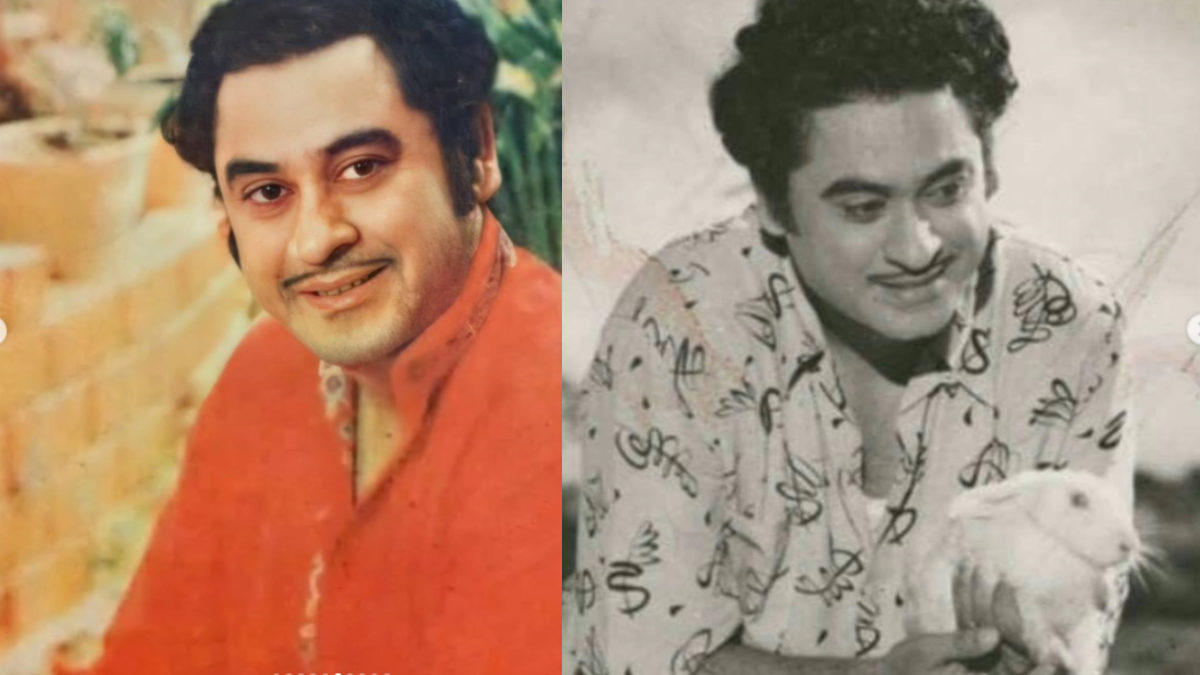
Every generation believes it has discovered Kishore Kumar. For some, he is the carefree voice behind Mere Sapno Ki Rani. For others, he is the aching soul of Kuch Toh Log Kahenge. Some remember the effortless romance of Pal Pal Dil Ke Paas, while others cannot imagine Amitabh Bachchan without the swagger he brought to Khaike Paan Banaraswala. Yet nearly four decades after his passing, Kishore Kumar remains one of Indian cinema’s greatest mysteries. The more one listens to him, the more one realises that he was never merely a playback singer. He was perhaps the only artist who dissolved the boundaries between acting and singing so completely that audiences stopped noticing where one ended and the other began.
Born as Abhas Kumar Ganguly on August 4, 1929, in Khandwa, Kishore Kumar never underwent formal classical training, a fact that still surprises many music lovers. At a time when technical perfection and rigorous classical grounding defined excellence in playback singing, he relied almost entirely on instinct, observation and an extraordinary musical ear. Conventional wisdom would suggest that such an approach should have limited his artistic range. Instead, it became the very foundation of a style that no institution could have taught and no subsequent singer has truly been able to replicate. His voice was not shaped inside a classroom. It was shaped by curiosity, experimentation and an uncanny ability to understand human emotion. That instinctive quality continues to separate him from almost every playback singer before or after him.
Another fascinating aspect of his journey is that Kishore Kumar did not initially aspire to become the singular voice that history remembers today. Like countless young singers of his generation, he idolised K. L. Saigal and even attempted to sing in a style reminiscent of his legendary predecessor. The turning point came when he gradually abandoned imitation in favour of discovering a voice that belonged entirely to him. His celebrated yodelling, inspired by Western entertainers including Jimmie Rodgers and Danny Kaye, was not a borrowed trick designed to impress audiences. Rather, he absorbed those influences and transformed them into something that felt completely at home within Indian film music. What emerged was not a copy of the West but an entirely original musical identity that audiences had never encountered before.
Perhaps the most extraordinary quality of Kishore Kumar’s artistry, and one that even many lifelong admirers rarely stop to analyse, was his remarkable ability to disappear into the personality of the actor he was singing for. Most playback singers lend their own voice to different stars. Kishore Kumar seemed to lend each star their own voice. Listen carefully to his recordings across decades and subtle distinctions begin to emerge. His singing for Dev Anand carried effortless sophistication and urban charm. For Rajesh Khanna, the voice became warmer, softer and almost flirtatious, perfectly complementing the superstar’s romantic persona. When Amitabh Bachchan redefined Hindi cinema with the Angry Young Man image, Kishore instinctively introduced greater authority, swagger and controlled aggression into his vocal delivery. During the disco era, he adapted yet again, matching Mithun Chakraborty’s youthful energy without ever sounding like he was chasing changing trends. The listener still recognised Kishore Kumar, but somehow believed that the actor on screen was the one expressing those emotions. That extraordinary illusion remains one of the defining achievements of playback singing in Indian cinema.
Ironically, this effortless mastery came only after years of struggle. Before Aradhana transformed his career in 1969, Kishore Kumar had spent almost two decades fighting to be recognised primarily as a playback singer. The industry saw him as an entertaining comic actor, an unpredictable performer and, perhaps unfairly, as Ashok Kumar’s younger brother. Then came Mere Sapno Ki Rani and Roop Tera Mastana, songs that not only changed his own career but also altered the soundscape of Hindi film music. Almost overnight, Kishore Kumar became the defining male playback voice of an era, a position he would continue to occupy for nearly two decades.
His background as an actor and comedian also left a lasting imprint on his singing in ways that listeners often experience subconsciously rather than consciously. His songs are filled with delicate vocal expressions that cannot easily be written into musical notation. A fleeting laugh, an unexpected sigh, a playful pause, a spoken phrase or a moment of silence would suddenly appear, making every recording feel spontaneous and deeply personal. Even his most romantic songs often resembled intimate conversations rather than carefully rehearsed studio performances. He approached the microphone not as a singer delivering notes but as a performer inhabiting a character, allowing emotion to guide technique rather than the other way around. It is precisely this quality that has prevented many of his recordings from sounding dated despite the passage of several decades.
The popular image of Kishore Kumar as Hindi cinema’s lovable eccentric has, over the years, become so deeply embedded in public memory that it has sometimes overshadowed another equally important aspect of his personality. Stories about warning boards outside his residence, unusual behaviour or his refusal to work under certain circumstances have acquired an almost mythical status. Yet musicians, composers and collaborators who worked closely with him consistently described another side of the man. Once he agreed to record a song, he arrived prepared, understood the emotional requirements almost instantly and often completed recordings with astonishing speed and precision. The folklore surrounding his eccentricities may make for entertaining anecdotes, but it tells only part of the story. Behind the humour and unpredictability stood an artist of remarkable discipline and creative clarity.
To reduce Kishore Kumar’s legacy solely to playback singing would also be to overlook the astonishing breadth of his creative contributions. He acted, directed, produced, composed music, wrote lyrics and remained actively involved in multiple aspects of filmmaking throughout his career. Very few personalities in Indian cinema have displayed such versatility across so many disciplines while achieving excellence in each. His contribution extends beyond Hindi cinema as well. His Bengali songs continue to enjoy an almost timeless appeal, with many listeners considering them among the finest recordings of his career. Together, these bodies of work reveal an artist whose creativity could never be confined by language, profession or convention.
His achievements are impressive even when viewed through numbers alone. Kishore Kumar won a record eight Filmfare Awards for Best Male Playback Singer and recorded thousands of songs across several Indian languages while remaining the defining voice for multiple generations of leading men. Yet statistics alone cannot explain why his influence continues to endure. Indian cinema has produced technically superior singers, classically accomplished vocalists and commercially dominant stars across different eras. What it has not produced is another Kishore Kumar, because originality of this kind cannot be manufactured, trained or consciously recreated.
Perhaps the most fitting tribute on his 97th birth anniversary comes from those who knew him best. Reflecting on his enduring legacy, his sons Amit Kumar and Sumeet Kumar recently observed, “You can’t recreate Kishore Kumar, only celebrate him.” It is a simple statement, but one that captures a profound truth. Kishore Kumar was never merely singing songs. He was performing the emotions that existed between the lyrics, giving every composition a life that extended far beyond melody and words. That is why generations continue to discover him afresh, and why, nearly a century after his birth, he remains less a playback singer and more an enduring phenomenon of Indian cinema.