
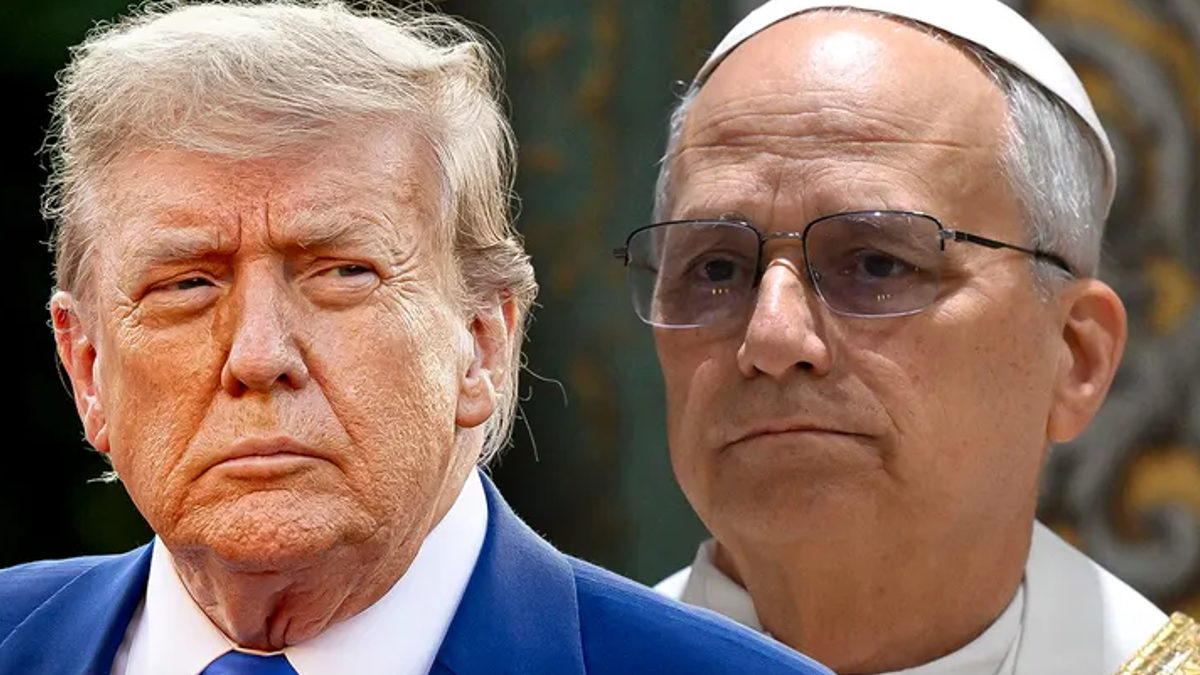
The intersection of politics and religion has always been sensitive territory, but the latest exchange between Donald Trump and Pope Leo XIV has pushed that tension into a far more public and personal space. In a strongly worded social media post, Trump openly criticized the Pope’s stance on crime and foreign policy, calling him weak and ineffective. The remarks did not stop at policy disagreements. They quickly escalated into personal territory, with Trump even drawing comparisons between the Pope and his brother, suggesting he preferred the latter’s ideological alignment.
This kind of rhetoric signals a shift in how political discourse is being conducted at the highest levels. What was once confined to diplomatic statements and carefully worded responses is now unfolding in real time, on public platforms, in language that is far more direct and confrontational.
At the core of this clash are deeper disagreements over global issues. The Pope’s criticism of recent military actions, particularly involving Iran, appears to have struck a nerve. His suggestion that global conflicts may be driven by a sense of unchecked power challenges not just specific decisions, but the broader philosophy behind them.
For Trump, this criticism was framed not as a moral perspective, but as political opposition. His response positioned the Pope’s views as aligned with what he described as the “Radical Left,” effectively turning a religious critique into a partisan issue.
This moment reflects a broader trend where traditional boundaries between institutions are increasingly blurred. Religious leaders are stepping into global political conversations, while political leaders are responding in ways that treat those voices as direct opposition rather than moral commentary.
There is also a media dimension to this. Statements like these are not just responses, they are content. They are designed to circulate, provoke reactions, and dominate conversation cycles. In that sense, the exchange becomes less about resolution and more about visibility.
What makes this situation particularly significant is the symbolism involved. The Pope represents one of the most enduring moral authorities in the world, while the presidency represents one of the most powerful political offices. When those two collide publicly, it shifts the tone of global discourse.
It also raises questions about the role of influence. When leaders speak, they are not just addressing each other. They are speaking to millions of followers who interpret, amplify, and react. The language used at the top often trickles down, shaping how conversations happen at every level.
At the same time, this is not entirely unprecedented. History has seen moments where political and religious leaders have clashed over ideology and policy. What is different now is the speed and scale at which these disagreements play out. Social media removes the buffer, turning what could have been a measured exchange into an immediate and highly visible conflict.
Ultimately, this is not just about one statement or one disagreement. It is about how power communicates in the modern era. It is about how authority is asserted, challenged, and perceived in a world where every word is instantly public.
Whether this moment leads to further escalation or quiet recalibration remains to be seen. But one thing is clear. The line between political strategy and public spectacle continues to blur, and moments like these only make that boundary harder to define.