
There are films that make you wait because of their stars. There are films that make you wait because of their directors. Then there are films that make you wait because they leave you with a question that refuses to leave your mind. For me, Toxic: A Fairy Tale for Grown-Ups falls firmly in the last category. It is one of those rare titles that doesn’t merely introduce a film. It starts a conversation.
Even before watching the film, I found myself trying to understand what exactly those six words were attempting to say together. The more I thought about them, the more they appeared deliberately contradictory, almost as though the title itself wanted the audience to pause before moving ahead.
The first word, Toxic, is perhaps the easiest to understand. It is a term we use almost every day now. We speak of toxic relationships, toxic ambition, toxic workplaces, toxic masculinity, toxic politics and toxic environments. The word immediately prepares us for a world that is emotionally poisoned, morally complex and psychologically unsettling. It is a word that carries discomfort even before it carries meaning.
Then comes the phrase that completely changes the conversation. A Fairy Tale for Grown-Ups. That is where curiosity takes over.
Fairy tales belong to childhood. They are built around innocence, imagination and hope. They ask children to believe that good eventually triumphs over evil and that every impossible dream deserves a chance. Adults, however, don’t see the world through innocence. They see it through ambition, desire, betrayal, obsession, revenge, trauma and compromise. Their realities are seldom simple and almost never magical.
So what exactly is a fairy tale meant for adults? The phrase almost sounds impossible. And perhaps that is precisely why it is so fascinating.
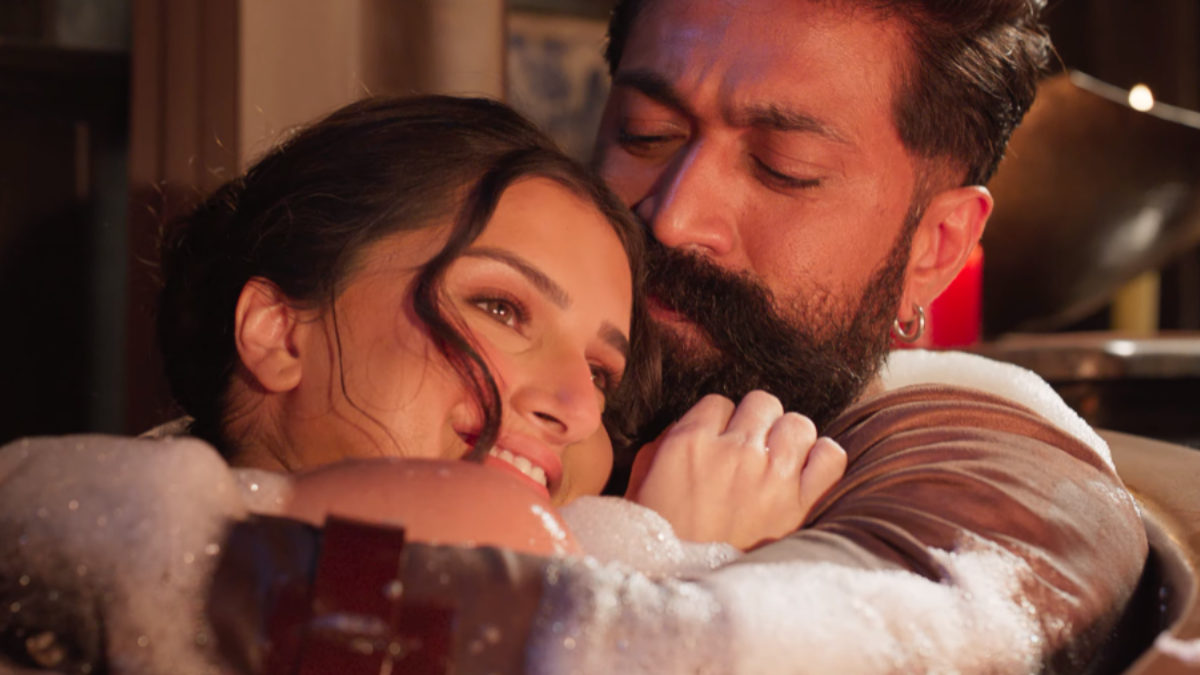
The visuals released so far only deepen that intrigue. They don’t resemble the comforting world one associates with fairy tales. They are stylised, visually extravagant, emotionally charged and filled with characters who appear to inhabit a world where morality itself seems blurred. Nothing appears ordinary. Nothing appears grounded in realism. Everything seems heightened, almost dreamlike, yet undeniably dark.
When those visuals are viewed alongside the title, one begins to wonder whether this is less about a fairy tale and more about what remains of one after innocence has disappeared. Perhaps that is what makes it a fairy tale for grown-ups. Not because adults need fairy tales, but because adulthood rewrites every fairy tale it touches.
The prince may no longer be heroic. The villain may not even know he is one. Love may become obsession. Power may replace virtue. Happy endings may become impossible. The castles remain, but the innocence does not. That is only one interpretation, of course.
Another equally interesting possibility is that the subtitle isn’t describing the story at all. Perhaps it is describing the experience. Children surrender themselves completely to fairy tales without questioning logic or realism. Maybe the filmmakers are asking adults to do exactly the same while promising that the emotions, conflicts and consequences inside this world will belong entirely to them.
Whether that is the intention or not is something only the film can answer.
What I appreciate, however, is that the title has already succeeded in making me ask these questions. That is becoming increasingly rare in mainstream cinema.
Most titles today tell us exactly what to expect. They announce the hero, establish the conflict or reveal the world. Toxic: A Fairy Tale for Grown-Ups does the opposite. It withholds answers. It invites interpretation. It creates curiosity rather than certainty. That also makes it one of the boldest promises a title can make.
When a filmmaker chooses a title like this, the audience naturally expects storytelling that is equally fearless. The title promises more than style. It promises an idea. It promises that there is a reason these seemingly contradictory words belong together.
If the film eventually earns that promise, the title could become one of those rare examples where every word acquires a richer meaning after the credits roll. If it doesn’t, the title may ultimately feel more profound than the story it introduces. Either way, I find myself waiting.
Not because I expect another action spectacle. Not because of the scale or the star power. I am waiting to discover why someone chose to call this film Toxic: A Fairy Tale for Grown-Ups. The answer may lie in the story, or it may lie in the way the story is told.
Until then, I have no intention of claiming what the film is about. This is simply one viewer’s interpretation of a title and the officially released promotional material. But when a title alone can provoke this much thought months before release, it has already achieved something that very few films manage to do.
Sometimes the first story a film tells isn’t through its trailer. It begins with its title.