
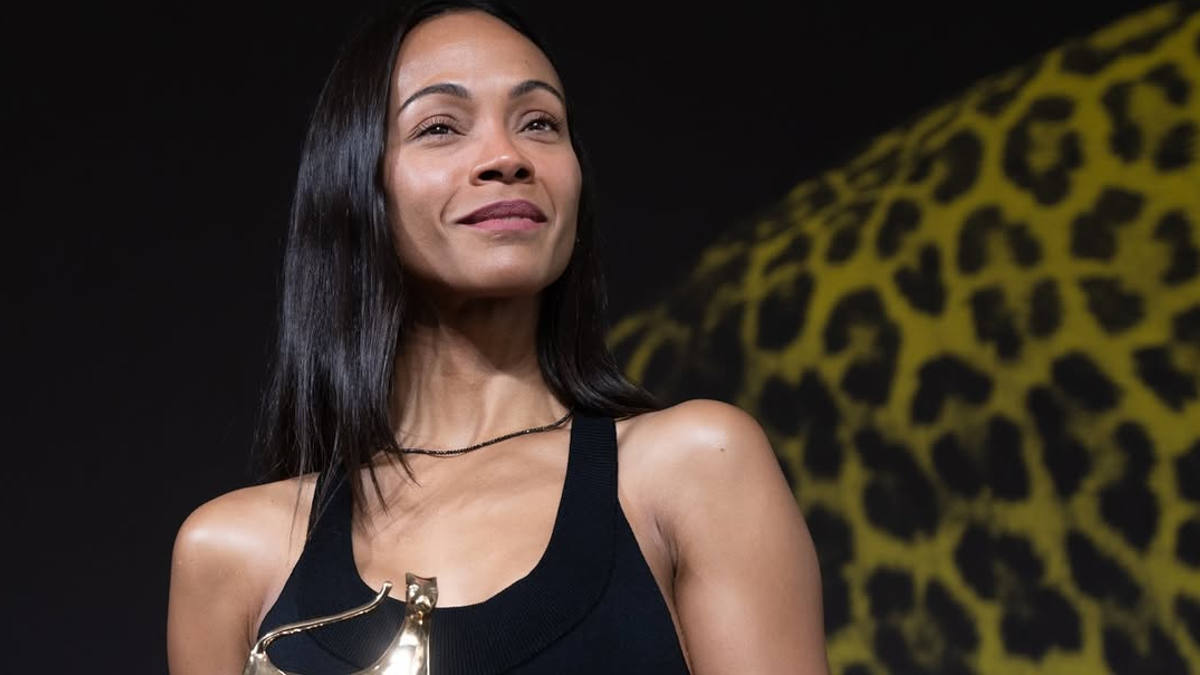
Zoe Saldaña has questioned why women and actors of colour are so often expected to answer for Hollywood’s wider problems of representation and inclusivity, arguing that journalists should be putting those questions to the industry’s gatekeepers instead.
Speaking during a public conversation at the 79th Locarno Film Festival on August 10, where she received a Special Pardo honour for her career, the Oscar winning actress said she finds it increasingly frustrating when she is the only woman or person of colour on a panel and is then asked a political or industry question instead of being allowed to discuss her craft.
Saldaña pointed to the kind of question she is regularly asked as an example, saying that when she is the only person of colour or the only woman on stage, she can end up being asked what needs to be done to make films more inclusive. Her objection was not to the importance of the subject itself, but to who is repeatedly expected to provide the answers.
She suggested that journalists should direct those questions towards the people who actually have the power to influence how the industry operates. In her view, asking the other people in the room who form part of the industry’s gatekeeping structure would put the responsibility where it belongs, rather than placing it on the one person from a marginalised group who happens to be on the panel. Saldaña said the existing pattern effectively makes people of colour work twice as hard simply to have a place in the room.
The remarks are particularly relevant given Saldaña’s own position in Hollywood. She has spent more than two decades moving between major studio franchises including Avatar, Star Trek and Guardians of the Galaxy, while also earning an Academy Award for her performance in Emilia Pérez. Her career has consequently put her in a rare position where questions about representation, access and the treatment of people of colour frequently intersect with conversations about the commercial film industry itself.
Her comments also underline a broader issue with the way film press conferences and promotional interviews can frame conversations around representation. Saldaña is not arguing that actors should never be questioned about political or social issues. Rather, her frustration is with a pattern in which women and people of colour can be treated as representatives of an entire industry problem while the executives, financiers and other decision makers who control access to projects are not necessarily subjected to the same questions.
The timing also makes the remarks relevant beyond the Locarno stage. Saldaña has previously found herself answering questions about representation and cultural sensitivity around projects such as Emilia Pérez, making her latest comments less an isolated complaint and more a reflection on a recurring part of the modern film publicity circuit.
For Saldaña, the issue ultimately appears to be one of accountability. If Hollywood is being questioned about who gets opportunities, who gets funded and whose stories reach audiences, she believes those questions should travel further up the chain of power instead of repeatedly landing on the shoulders of the people who are already fighting to get through the door.