
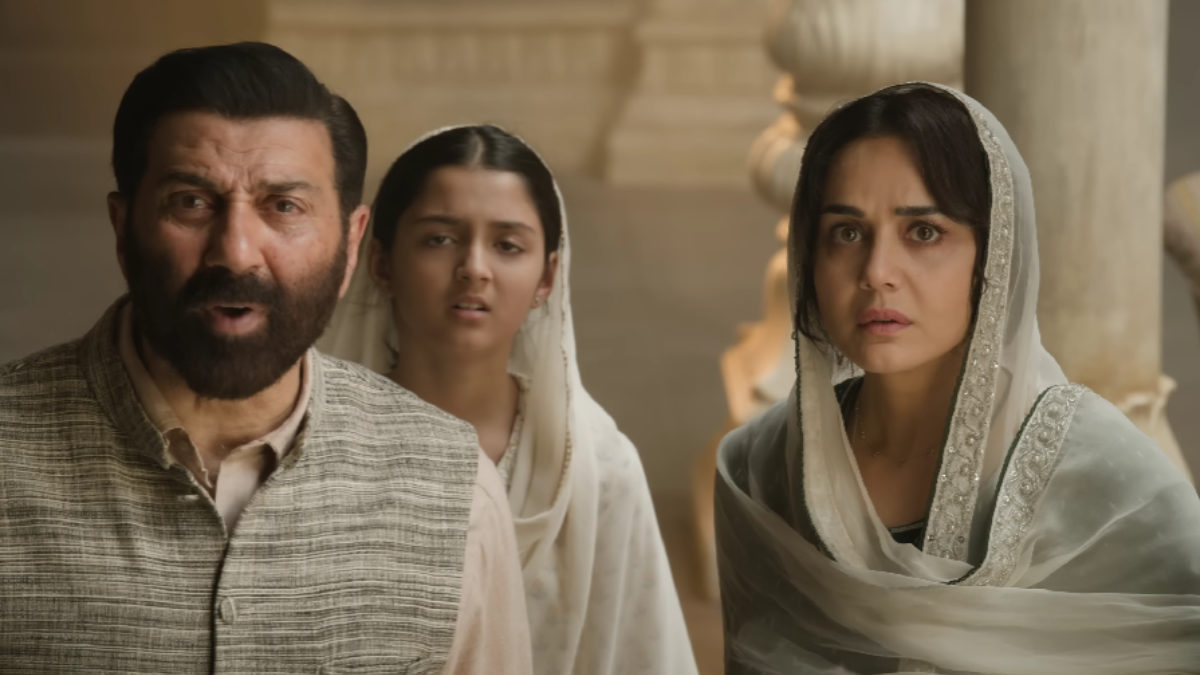
Batwara 1947 is set against the backdrop of the 1947 partition of India and the division of Punjab, is based on Asghar Wajahat’s drama Jis Lahore Nai Vekhya, O Jamya E Nai. Set in Lahore in the aftermath of Partition, Batwara 1947 follows Sikander Mirza (Sunny Deol), his wife Hamida (Preity Zinta) son Javed (Karan Deol) and daughter Tanno (Khushi Hajare), muhajirs from Lucknow who are allotted a sprawling haveli left behind by a Hindu family. Their arrival takes an unexpected turn when they discover Mai (Shabana Azmi), an elderly Hindu woman who has stayed back waiting for her son’s family to return, refusing to leave the home she still considers hers.
What begins as an uncomfortable confrontation gradually develops into an unlikely bond as Mai becomes part of the Mirza family’s everyday life. Outside the haveli, however, communal tensions are rising. Yaqoob Pehalwan (Abhimanyu Singh), a self proclaimed defender of Islam, sees Mai’s presence as unacceptable and pressures Sikander to send her to India. A local Maulvi, meanwhile, represents the more compassionate side of faith, arguing for coexistence and respect. Refugee poet Habib Anwar (Ali Fazal) adds another emotional layer to the narrative, giving voice to the grief, nostalgia and displacement that came with Partition.
The premise of Batwara 1947 is not particularly designed to entertain in the conventional sense. It is a film with a clear soul and an equally clear message about humanity rising above religious identity and communal divisions. The subject itself is deeply sensitive, given the emotions and memories surrounding Partition that continue to resonate even today. Films that revisit this painful chapter of history can serve a purpose when they encourage reflection rather than simply reopening old wounds, and Batwara 1947 clearly attempts to do that by placing humanity at the heart of its narrative.
The difficulty is that the film does not always find the cinematic language required to carry the weight of its subject. Much of the responsibility falls on Sunny Deol, who as Sikander Mirza tries to keep the screenplay afloat through his visual communication and presence. His hard hitting dialogues, particularly in the post interval portions, bring the film some much needed intensity and give the proceedings the force that is otherwise missing in parts.
The performances, however, often appear more theatrical than cinematic. Preity Zinta and Karan Deol seem out of sync with the world around them, making some of their scenes feel forced rather than organic. Shabana Azmi as Mai is passable to good and attempts to bring the required emotional depth to the character, although her makeup and physical appearance sometimes feel disconnected from the character and the period being portrayed.
Abhimanyu Singh does what is required as Yaqoob Pehalwan and brings a degree of tension to a narrative that occasionally struggles to maintain momentum. His presence gives the conflict a recognisable face. Ali Fazal’s Habib Anwar, on the other hand, is an immediately likeable character. He brings warmth and sensitivity to the proceedings, although the character appears only sporadically and therefore never gets the opportunity to make the impact one expects.
The supporting cast largely stays within the framework created by the director, with most performers serving the story rather than drawing attention to themselves. From a purely cinematic perspective, however, Batwara 1947 has limited ammunition. It is the dialogues, emotions and situations that do most of the heavy lifting. The filmmaking rarely rises above the material to give it a stronger visual or dramatic identity.
The final sequence is where the film finds its emotional rhythm. It carries the weight that the narrative has been building towards and provides a sense of relief after the tension and conflict. It is also the point where the film’s central thought comes through most clearly, without needing to explain itself too much.
The music and lyrics pass muster but do little to enhance the proceedings. They neither disrupt the narrative nor add much to its emotional impact, making them largely incidental to the experience.
Ultimately, Batwara 1947 is not a film one would walk into expecting conventional entertainment. Its strength lies in the question it raises about whether humanity can survive when religious identity becomes more important than human relationships. The execution may not always match the importance of that idea, and the performances and cinematic treatment occasionally make the film feel stagy, but the intention remains sincere.
With its ‘A’ certificate and its subject matter, Batwara 1947 is likely to find greater resonance among mature audiences, particularly millennials who can engage with the historical and emotional gravity of Partition. It may not be an entirely accomplished cinematic experience, but its heart is in the right place, and sometimes that is what makes a film worth discussing.
Movie: Batwara 1947
Directed by: Rajkumar Santoshi
Based on: Jis Lahore Nai Vekhya, O Jamya E Nai by Asghar Wajahat
Featuring: Sunny Deol, Preity Zinta as Hamida, Shabana Azmi, Karan Deol, Ali Fazal, Abhimanyu Singh, Khushi Hajare
Music by: A. R. Rahman
Theatrical Release date: 14 August 2026
Run Time: 2hrs 25mins
Batwara 1947
3