
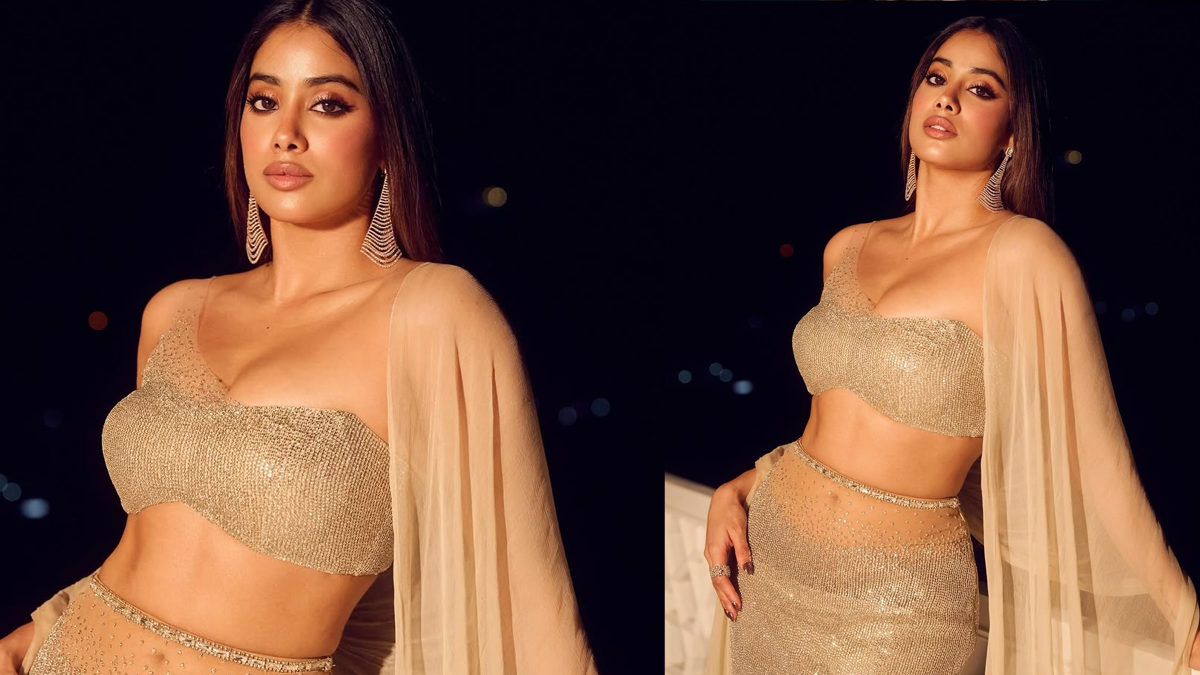
A single YouTube thumbnail was enough to spark a major social media controversy. Popular content creator Dhruv Rathee recently found himself at the centre of an online storm after using a before-and-after image of actor Janhvi Kapoor in the thumbnail of a video that discussed the concept of “fake beauty” and cosmetic enhancements. What began as criticism over the thumbnail soon escalated when several social media users claimed that Rathee’s video was a targeted response to Janhvi’s recent post supporting Hindus in Bangladesh.
As the narrative gained traction across platforms, Rathee addressed the controversy in a follow-up video, firmly dismissing the claims as misleading and illogical. He directly responded to a viral post accusing him of deliberately attacking Janhvi Kapoor, questioning why people were accepting such conclusions without basic reasoning.
Rathee pointed out that the timeline itself made the accusations unrealistic. He explained that his video, which runs over 30 minutes, was uploaded on the same day Janhvi shared her post. Emphasising the impracticality of scripting, recording, editing, and publishing a detailed video within such a short span solely as a reaction, he asked viewers to apply simple logic before believing social media narratives.
He also rejected the idea that he would criticise someone for speaking out on the issue of Bangladeshi Hindus. Rathee reminded viewers that he has himself created content addressing the same topic in the past. According to him, it would make little sense for him to oppose a stance he personally supports. He reiterated that he prefers direct communication and does not engage in indirect attacks or hidden messaging.
Clarifying the intent of the video, Rathee stressed that the discussion focused on plastic surgery, beauty standards, and their broader impact on society. He stated that the video did not question or criticise Janhvi Kapoor personally and that her image was used only as part of a larger conversation around public perception and cosmetic procedures. He added that throughout the video, he did not pose any questions to Janhvi or comment on her political views.
Following his clarification, the speculation began to slow, though the episode once again highlighted how quickly online debates can spiral based on assumptions. The controversy also reinforced Rathee’s position as one of the most polarising digital voices in India—someone whose content often triggers strong reactions across ideological lines.
Beyond the controversy, Dhruv Rathee’s journey as a creator has been shaped by a long-standing interest in storytelling, travel, and public affairs. Born in 1994 in Rohtak, Haryana, Rathee grew up in a middle-class family. His mother worked as a school teacher, while his father was an engineer. His early years were marked by frequent travel within India, which later expanded internationally when his father took up work in Malaysia.
It was during a visit to Malaysia in 2003 that Rathee first picked up a camera and recorded his earliest video. Though small and informal, the experience left a lasting impression and planted the seeds for what would eventually become a career in content creation.
As a teenager, Rathee’s interests evolved significantly. While he initially enjoyed animation and detective stories, his curiosity gradually shifted toward documentaries, global issues, and current affairs. A defining moment came in 2011 during the Anna Hazare-led anti-corruption movement. Witnessing the scale of public mobilisation and debate sparked his interest in politics, governance, and accountability.
Rathee later moved to Germany for higher education, enrolling at the Karlsruhe Institute of Technology. He completed a Bachelor’s degree in Mechanical Engineering, followed by a Master’s degree in Renewable Energy in 2018. Despite his technical academic background, his passion for understanding economic systems and political structures continued to grow alongside his studies.
To deepen his understanding of these subjects, Rathee went on to pursue a second bachelor’s degree in economics and political science. Over time, he combined his academic learning with digital storytelling, using online platforms to explain complex issues in accessible formats.
The recent thumbnail controversy serves as another reminder of how visual elements and assumptions can overshadow content intent in the age of social media. While Rathee’s clarification may have slowed the backlash, the incident reflects the broader dynamics of online discourse, where narratives can form rapidly and facts often struggle to catch up.