
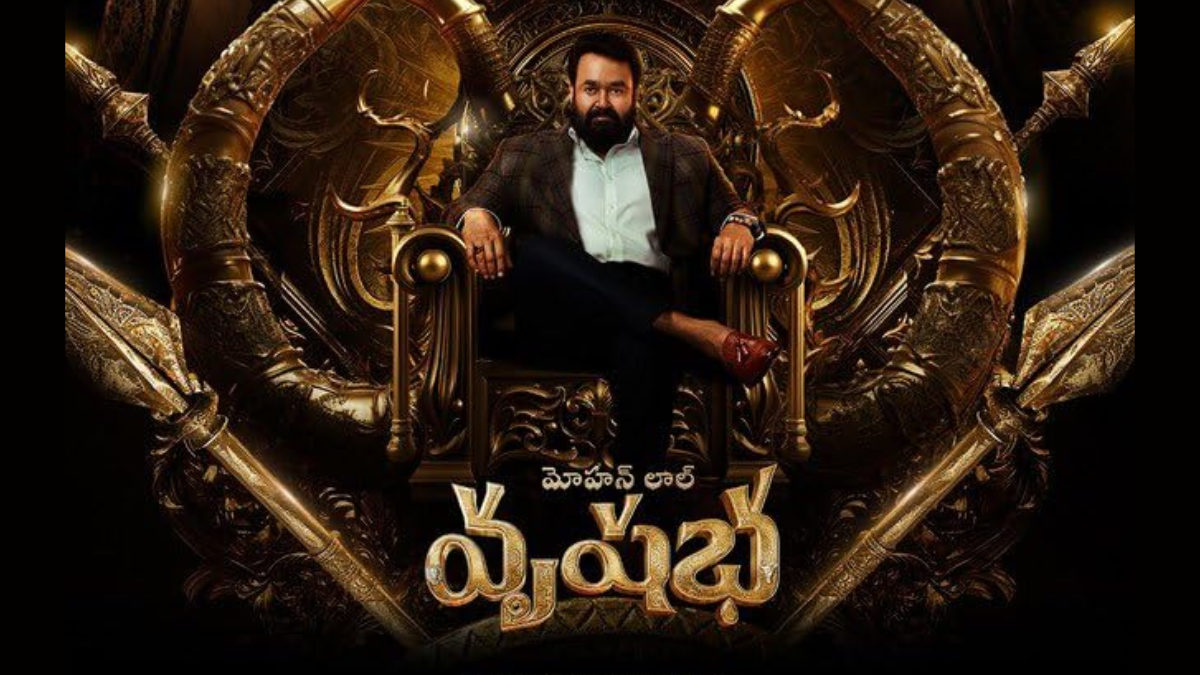
For most of 2025, Mohanlal appeared to be enjoying one of the strongest commercial phases of his career. Back-to-back successes reaffirmed his box-office authority, and the narrative around the “Complete Actor” seemed unassailable. That makes the fate of Vrusshabha all the more startling. Positioned as a big-ticket, pan-Indian spectacle and mounted on a reported budget of ₹70 crore, the film has ended its theatrical run as the biggest commercial disaster of Mohanlal’s career—and one of the most severe box-office collapses seen in recent Indian cinema.
The numbers leave little room for debate. Trade estimates place the film’s India opening day collections at around ₹60–61 lakh, among the weakest openings for a Mohanlal release in the modern era. After six days, worldwide theatrical collections reportedly stalled at approximately ₹2.04 crore. Against a production cost of ₹70 crore, this translates into a recovery of less than three per cent, or a deficit of roughly 97 per cent—an extraordinary figure for a film carrying such scale, ambition, and star value.
A closer look at the language-wise performance underscores the depth of the rejection. On day one, the Malayalam version reportedly collected around ₹46 lakh, while the Hindi version struggled at about ₹2 lakh. Other dubbed versions failed to make any meaningful impact. This was not a case of one market underperforming while another compensated; Vrusshabha failed to connect across the board.
Released on Christmas Day, the film was clearly designed as a festive tentpole. Instead, it encountered swift and decisive resistance from both critics and audiences. Reviews were largely unforgiving, describing the film as an uninspired reincarnation drama weighed down by weak writing and uneven execution. Particular criticism was directed at the visual effects, with several reviewers calling the AI-assisted imagery distracting or even unintentionally comic. The screenplay, meanwhile, was widely labelled rushed and emotionally hollow.
Ironically, the very element meant to anchor the film—Mohanlal’s dual role as a medieval king and a contemporary businessman—proved insufficient. Trade commentary repeatedly pointed to a wafer-thin story and tacky dialogue that failed to exploit the dramatic potential of the concept. In a market increasingly driven by content credibility, scale alone could not compensate for the lack of narrative depth.
The timing of the release further complicated matters. The Christmas corridor was crowded, and competing titles quickly seized audience attention. Most notably, the Hindi hit Dhurandhar dominated the festive box office, leaving little oxygen for a film already struggling with poor word of mouth. Within days, exhibitors in Kerala reportedly began replacing Vrusshabha to minimise losses—a rare and telling move for a Mohanlal-led project. In many centres, the film failed to complete even a full week in theatres.
What makes this collapse particularly historic is the contrast with Mohanlal’s other releases in the same year. L2 Empuraan opened with massive momentum and went on to achieve all-time blockbuster status. Thudarum sustained strong weekend growth to emerge as a blockbuster, while Hridayapoorvam comfortably secured a super-hit verdict. Against these films, Vrusshabha appeared dead on arrival, showing no signs of a weekend rebound.
The day-wise India net figures tell a stark story. From ₹0.60 crore on day one, collections fell sharply to ₹0.32 crore on Friday, then slid further over the weekend, dropping to ₹0.19 crore on Saturday and ₹0.10 crore on Sunday. By Monday and Tuesday, daily numbers were negligible, prompting widespread removal from screens. For exhibitors, the decision was pragmatic rather than dramatic: continuing to run the film meant compounding losses.
Historically, the scale of the failure is what sets Vrusshabha apart. L2: Empuraan reportedly earned more in its first 48 hours than Vrusshabha is expected to make over its entire theatrical lifetime. Ticketing data paints an equally grim picture, with Thudarum clocking millions of admissions while Vrusshabha reportedly managed only around 14,000 tickets in its first five days—a career low for the superstar.
As the industry looks toward 2026, focus shifts to Mohanlal’s upcoming Drishyam 3. Vrusshabha, however, will linger as a cautionary tale—proof that in today’s theatrical ecosystem, star power and scale cannot override weak storytelling. For the trade, it is a reminder that spectacle without substance is no longer a risk worth taking.
Note: Box-office figures mentioned are based on trade estimates and publicly reported data from multiple industry trackers and may vary slightly from final audited numbers.