
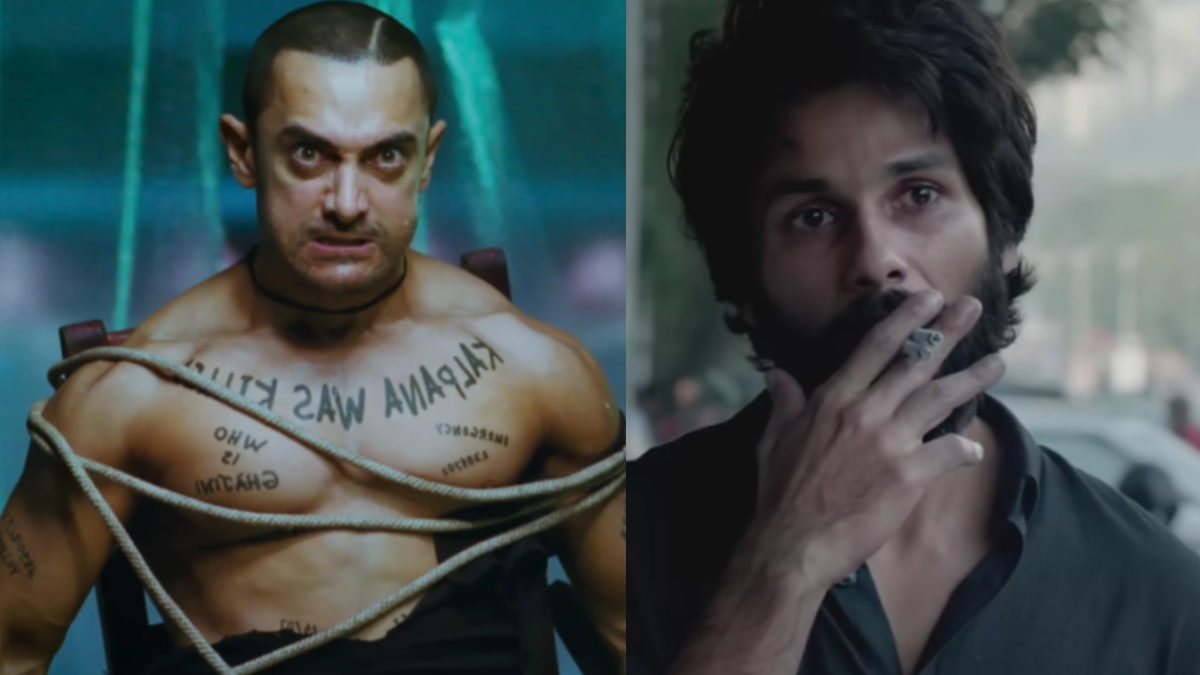
The collaboration between Bollywood actors and South Indian directors hasn’t just been about remakes or market expansion. In many cases, it has completely reshaped star images, unlocked new box office potential, and even revived careers. Here’s a closer look at some of the most defining collaborations and what they meant for the actors involved. Here are some Bollywood–South collaborations that redefined both mainstream cinema and the stars at the center of it.
Aamir Khan (Ghajini, 2008)
Directed by A. R. Murugadoss
This wasn’t just a film, it was a turning point in how Bollywood approached commercial storytelling. Aamir Khan underwent a drastic physical transformation, introducing the now-iconic eight-pack look to mainstream Hindi cinema. The film became Bollywood’s first ₹100 crore blockbuster, and its fragmented narrative style brought a fresh, high-concept approach to mass entertainers. It also marked the beginning of Aamir’s phase of blending content with scale.
Salman Khan (Wanted, 2009)
Directed by Prabhu Deva
Before Wanted, Salman Khan was going through a lull. This film changed everything. The raw, rugged, no-nonsense action hero that emerged here became Salman’s defining screen persona for the next decade. It also sparked Bollywood’s obsession with South remakes. The film’s success laid the foundation for Salman’s blockbuster streak with films like Dabangg and Bodyguard.
Sanjay Dutt (Policegiri, 2013)
Directed by K. S. Ravikumar
While the film itself didn’t achieve major success, it’s an interesting case of Sanjay Dutt attempting to tap into the South-style mass cop template. The larger-than-life presentation and punchline-heavy dialogues reflected Ravikumar’s signature style, even if it didn’t fully translate for the Hindi audience.
Ajay Devgn (Action Jackson, 2014)
Directed by Prabhu Deva
This was Ajay Devgn diving headfirst into exaggerated, stylised mass cinema. Known for his intense roles, Devgn experimented with over-the-top action and flamboyant characterisation. Though the film received mixed reactions, it showed how even established stars were willing to adapt to the South’s high-energy storytelling format.
Akshay Kumar (Holiday: A Soldier Is Never Off Duty, 2014)
Directed by A. R. Murugadoss
Akshay Kumar found a perfect balance between patriotism and commercial cinema with this film. Unlike typical actioners, Holiday focused on sleeper cells and urban terrorism, giving Akshay a more grounded yet heroic role. It reinforced his image as a dependable star in content-driven commercial films and performed strongly at the box office.
Shahid Kapoor (Kabir Singh, 2019)
Directed by Sandeep Reddy Vanga
Few films have impacted an actor’s career the way Kabir Singh did for Shahid Kapoor. His portrayal of a deeply flawed, intense character became a cultural talking point. Despite its controversies, the film emerged as one of the biggest hits of its time, giving Shahid his highest-grossing solo lead and redefining his position in the industry.
Salman Khan (Radhe, 2021)
Directed by Prabhu Deva
Reuniting with Prabhu Deva, Salman Khan returned to the mass action zone that once worked wonders for him. While Radhe didn’t replicate the success of Wanted, it reinforced how strongly Salman’s star image is tied to the South-style action format.
Shah Rukh Khan (Jawan, 2023)
Directed by Atlee
With Jawan, Shah Rukh Khan fully embraced the South-style mass hero template. The film presented him in multiple avatars, combining emotion, action, and whistle-worthy moments. It went on to become one of the biggest blockbusters in Hindi cinema history, re-establishing SRK’s dominance at the box office post-pandemic. Atlee’s signature storytelling gave SRK a larger-than-life canvas rarely seen in his recent filmography.
Ranbir Kapoor (Animal, 2023)
Directed by Sandeep Reddy Vanga
With Animal, Ranbir Kapoor stepped into a darker, more violent space than ever before. The film shattered box office records and showcased Ranbir in a raw, unapologetically intense avatar. Vanga’s storytelling pushed him beyond his comfort zone, resulting in one of the most talked-about performances of his career.
Varun Dhawan (Baby John, 2024)
Directed by Kalees
This film represents the new wave of direct South-to-Hindi collaborations. Varun Dhawan steps into a massy action space heavily influenced by Atlee’s filmmaking school. It signals a shift where younger Bollywood stars are actively adopting the South’s storytelling grammar to stay relevant in a pan-India market.
Shahid Kapoor (Deva, 2025)
Directed by Rosshan Andrrews
Expanding beyond Tamil and Telugu filmmakers, Deva brings Malayalam cinema sensibilities into Bollywood. Shahid Kapoor takes on a cop role rooted in realism and psychological depth, reflecting Andrrews’ grounded storytelling style. This collaboration highlights the widening influence of the entire South industry, not just its biggest commercial centers.
Salman Khan (Sikandar, 2025)
Directed by A. R. Murugadoss
This film marked Salman Khan’s collaboration with Murugadoss, raising expectations of a strong, content-driven action entertainer. However, despite the hype, it failed to click at the box office. It stands out as a reminder that even big star-director pairings in the Bollywood–South space don’t guarantee success without a solid narrative.
What stands out across these films is a clear pattern. South directors don’t just make Bollywood films, they repackage Bollywood stars. Whether it’s Aamir Khan’s physical reinvention, Salman Khan’s mass rebirth, or Shahid Kapoor’s career-defining intensity, these collaborations often mark a before and after moment.
And in today’s pan-India era, this is no longer an experiment. It’s becoming the blueprint.