
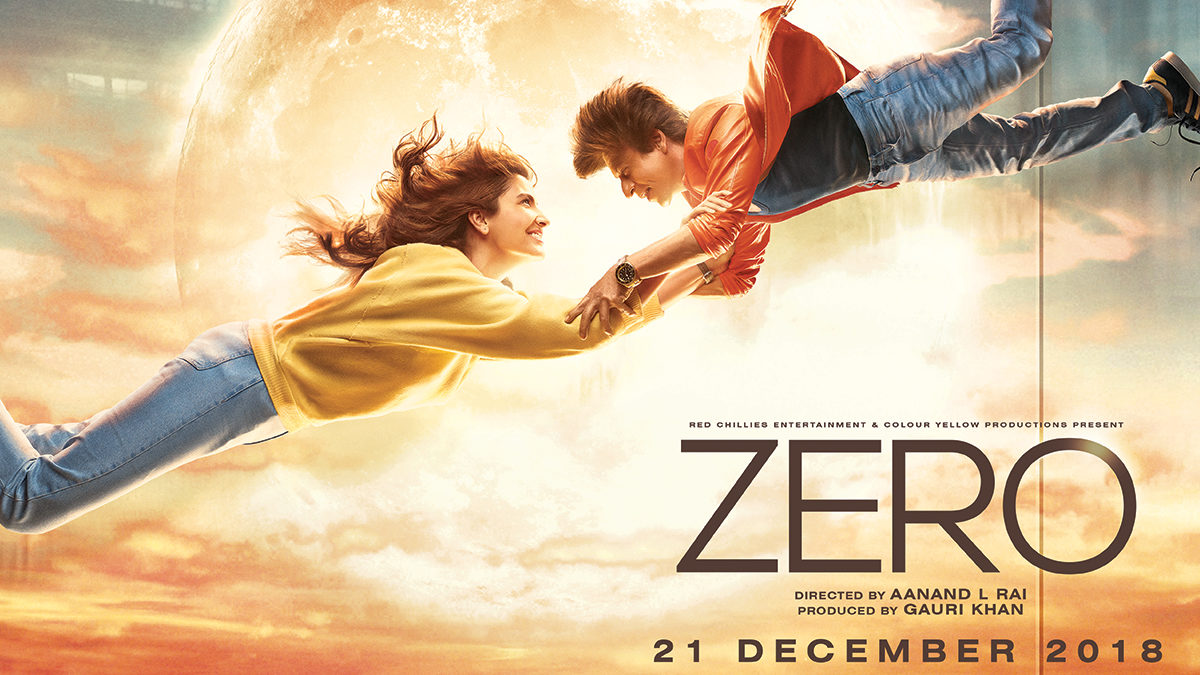
Nearly seven years after the release of Zero, the film continues to linger in the mind of its director, Aanand L Rai. Released in 2018 amid massive expectations, the Shah Rukh Khan–starrer was envisioned as an ambitious romantic drama that pushed creative boundaries. However, despite its scale, star power, and emotional intent, Zero failed to resonate with audiences and underperformed at the box office. Today, Rai openly shoulders responsibility for the film’s failure, candidly admitting that he did not succeed in weaving Shah Rukh Khan’s superstardom into the narrative.
Speaking in an interview with Galatta Plus, the filmmaker reflected on what went wrong with Zero and where he believes he faltered as a director. Rai acknowledged that while he approached the project with honesty and creative conviction, he underestimated the importance of accommodating the image and expectations that come with a superstar like Shah Rukh Khan.
“The problem with Zero was that, that man… that superstar came to me with so much of love,” Rai said. “And me being me, I never understood that it’s not an actor-director who was going to make a story. There was a superstar attached, his image is there, which I have to understand and get in the film.”
Rai admitted that he viewed Shah Rukh primarily as an actor rather than as a global icon with decades of cinematic legacy. “I was working with an actor, a big actor. I realised much later that there is an image that I had to take care of,” he added, underlining a realization that came too late in the filmmaking process.
The director further elaborated on how his filmmaking style—often praised for being free of star “baggage”—may have worked against him in this case. Rai is known for crafting grounded, character-driven stories, often led by unconventional protagonists. However, with Zero, that approach clashed with audience expectations attached to Shah Rukh Khan.
“When you say that my films are without the baggage of a star, somewhere I agree that maybe I am unable to incorporate that stardom in my characters,” Rai said. “At times, people want to see their stars in a character, but a part of the star should also be there, which I was unable to do.”
Describing the creative process, Rai confessed that he felt unanchored while making the film. “I was floating, those bearings were not there, they were moved,” he said, suggesting that the lack of clarity around balancing realism and stardom ultimately hurt the narrative.
Despite the film’s failure, Aanand L Rai emphasized that working with Shah Rukh Khan was a deeply rewarding experience. He spoke fondly of the actor’s humility and trust, while also acknowledging that neither of them paused to address the larger issue at hand.
“One of us should have stopped and said, ‘Hello, it’s not just actor-director, there is a star,’” Rai reflected. “He never brought it in front of me, I never understood that and somewhere I lost that thing.”
Zero featured Shah Rukh Khan as Bauua Singh, a man with dwarfism from Meerut, marking one of the most unconventional roles of his career. The film also starred Anushka Sharma as a brilliant scientist with cerebral palsy and Katrina Kaif as a troubled, emotionally fragile superstar. The story followed Bauua’s journey of love, heartbreak, and self-discovery as he found himself torn between two very different women.
Despite its emotional ambition and visual scale, the film struggled to connect with viewers. Made on a reported budget of ₹200 crore, Zero managed to collect only around ₹178 crore worldwide, ultimately being labelled a box office disaster. Following the film’s failure, Shah Rukh Khan took a significant break from acting, stepping away from the big screen for several years before making a powerful comeback.
For Rai, Zero remains a lesson in understanding the delicate balance between storytelling and stardom. His reflections highlight a rare moment of accountability in an industry where failures are often deflected or softened.
On the professional front, Aanand L Rai has since moved forward, continuing to explore emotionally layered narratives. He recently directed Tere Ishk Mein, starring Kriti Sanon and Dhanush, reaffirming his commitment to character-driven cinema.
While Zero may not have succeeded at the box office, Rai’s honest introspection has reopened conversations about how stars, stories, and audience expectations intersect. Years later, the film stands as both an ambitious experiment and a reminder that in mainstream cinema, stardom itself is a character that cannot be ignored.