
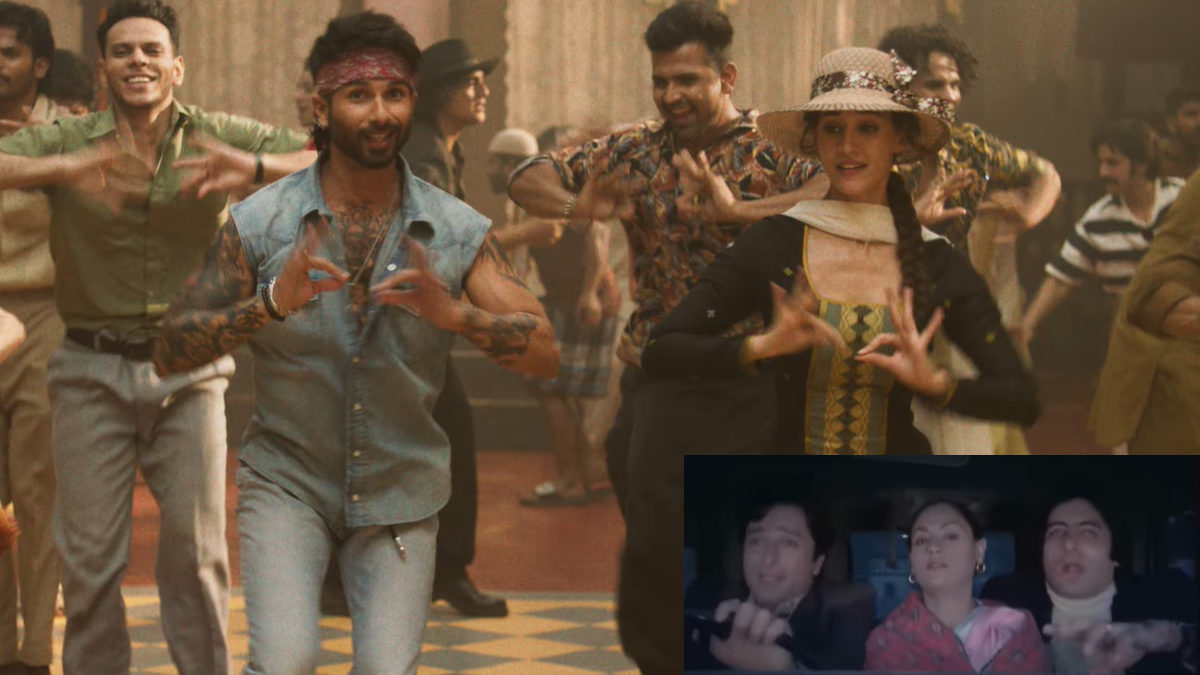
Some lines don’t just land — they trigger memory. When O’ Romeo rolled out the now-viral hook, “Neeche paan ki dukaan, upar Julie ka makaan…”, it sounded cheeky, rooted, almost mischievously local. It had the texture of something overheard in a bustling mohalla, the kind of rhyme that feels improvised yet oddly familiar. And that familiarity is where the intrigue begins. Because did you know that a remarkably similar line was uttered on screen more than four decades ago?
In Silsila, the romantic drama directed by Yash Chopra, there’s a fleeting but unforgettable moment: Shashi Kapoor’s Shekhar and Amitabh Bachchan’s Amit, slightly drunk and brimming with carefree abandon, chant during a jeep ride, “Neeche paan ki dukaan, upar gori ka makaan.” It isn’t a formal lyric. It isn’t even framed as poetry. It’s playful banter — rhythmic, repetitive, deliberately nonsensical — capturing the looseness of male camaraderie in a way only early ’80s Bollywood could.
The parallel is difficult to ignore. The rhyme scheme remains intact. The imagery is identical: a paan shop below, a woman upstairs. The only shift is semantic — “gori” replaced by “Julie.” A generic romantic archetype gives way to a specific name, but the cadence survives almost unchanged. The structure feels less like coincidence and more like an echo.
There has been no official word suggesting that Vishal Bhardwaj deliberately drew from Silsila. Yet Bhardwaj is hardly a filmmaker disconnected from cinematic memory. His storytelling often carries layered references and cultural callbacks that reward attentive audiences. The possibility that this is a subtle nod to a classic moment cannot be dismissed. At the same time, Hindi cinema has long embraced playful rhyming couplets as part of its informal lexicon, making it equally plausible that both lines spring from a shared idiom embedded in popular culture.
What adds a compelling layer to the comparison is context. In Silsila, the chant is a throwaway moment of levity — detached from the emotional complexities that define the film’s central relationship. It floats lightly, almost carelessly. If O’ Romeo deploys its version within a more stylised or layered narrative environment, the same rhythmic device carries different weight. A carefree drunken refrain from 1981 could now operate as a calculated hook, a character cue, or even a tonal statement.
Bollywood has always conversed with itself. Dialogues reappear in altered forms, refrains resurface across decades, and fragments of old films quietly embed themselves in new storytelling. Whether this similarity is conscious homage or subconscious recall, it highlights how cinema rarely moves forward without carrying pieces of its past.
And perhaps that isn’t the only echo worth noting. The playful “furr” that punctuates the energy of O’ Romeo also finds a contemporary parallel in the recently released track “Phurr” from Kis Kisko Pyaar Karoon 2, turning a whimsical sound effect into a recurring pop-cultural motif. Whether intentional or incidental, these overlaps suggest that Bollywood’s language — its rhymes, chants and exclamations — travels freely between eras.
From “gori ka makaan” in 1981 to “Julie ka makaan” today, and from “Phurr” to “Furrr,” Hindi cinema continues to remix its own memory. The address may change, the faces certainly do, but the rhythm refuses to fade.