
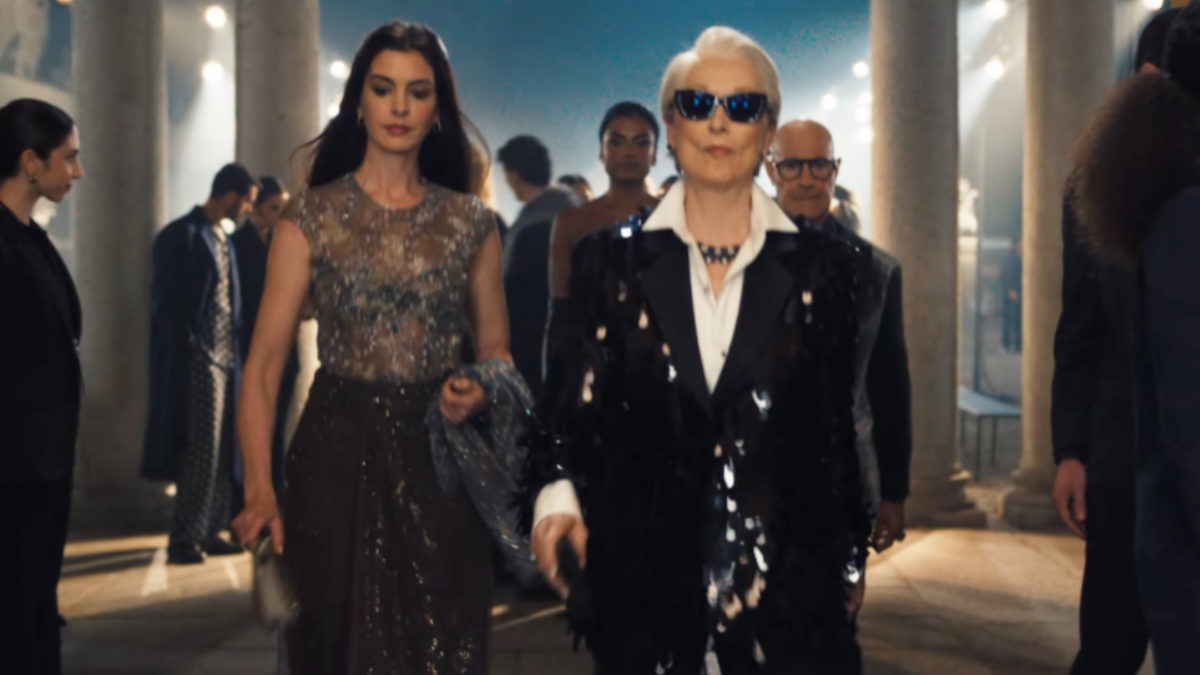
Two decades after The Devil Wears Prada became a defining pop culture moment, The Devil Wears Prada 2 arrives carrying the weight of nostalgia and expectation. What stands out almost immediately is that it does not depend on memory alone. It looks at the present, understands it, and quietly builds its own identity. The film opens with a sharp and very current reality. Mass layoffs, delivered through cold and impersonal communication, set the tone in a way that feels uncomfortably familiar. It draws you in not with drama, but with recognition. Within this shifting landscape, Andrea Sachs aka Andy (Anne Hathaway) finds her way back to Runway at a time when Miranda Priestly (Meryl Streep) is forced to confront a rapidly changing media world and the uncertain position of the publication within it. Their paths cross again not just out of nostalgia, but out of necessity, as the story brings them face to face with Emily Charlton (Emily Blunt), now heading a powerful luxury brand (Dior) whose backing could determine whether Runway survives at all.
From here, the film finds its voice through Andy’s perspective as she begins to question the place of journalism in a world driven by speed, visibility and short attention spans. What follows is a subtle but clear contrast between meaningful writing and a culture that often values scrolling over reading. The film gently points out that numbers can be misleading, that likes and views do not necessarily mean something has been understood or even fully consumed.
This idea runs quietly through the film and becomes one of its strongest strengths. There is a visible attempt to rethink what publication and content should mean today. The writing plays a big role here. The dialogues are sharp, witty and controlled, never loud, yet consistently effective. They land without trying too hard, allowing the audience to absorb the thought rather than be told what to feel.
At the heart of the film is Meryl Streep, whose presence alone brings a certain weight to every frame. She slips back into Miranda Priestly with ease, carrying the same authority but with a deeper sense of awareness. There is no struggle against time or change in her character, only an instinct to keep moving forward without losing control. Anne Hathaway brings a quieter, more reflective energy to Andy, making her journey feel more grounded. Stanley Tucci as Nigel Kipling, adds emotional warmth in a way that feels effortless. And then there is Emily, whose presence builds gradually to one of the film’s most satisfying moments when Andy finally tells her, “you are iconic.” It feels earned, not just within the story, but as a nod to everything the character has come to represent over time.
The film also knows when to have fun with its world. A brief appearance by Lady Gaga blends in naturally, adding a touch of surprise without feeling forced. At another moment, Vogue by Madonna lifts the mood instantly, reinforcing the strong connection between fashion, music and attitude that the film has always carried.
What works strongly in the film’s favour is its restraint with nostalgia. It acknowledges the past but does not depend on it. The callbacks are present, but they are integrated into the narrative rather than placed for effect. The characters are allowed to grow, and the world around them evolves with them.
Visually, the film remains true to its identity. The fashion continues to be a major attraction, supported by strong styling and production design that maintain the glossy appeal of this universe. The music and background score complement the mood without overpowering it, giving the film a smooth and engaging rhythm.
There is also a deeper layer that quietly reflects on work and purpose. The film contrasts the uncertainty of finding jobs today with an older generation’s instinct to keep working without distraction or excuse. It presents characters who are driven less by trends or money and more by a sense of identity tied to what they do.
The overall impact is subtle but lasting. The film does not try to outdo the original in scale or noise. Instead, it chooses awareness and relevance. It respects its legacy while accepting the realities of the present, and in doing so, it manages to feel both familiar and new at the same time.
It may not attempt to redefine what came before, but it adds a thoughtful and well-observed chapter to it, one that stays with you not because it demands attention, but because it earns it.
Movie: The Devil Wears Prada 2
Directed by: David Frankel
Written by: Aline Brosh McKenna
Based on Characters by: Lauren Weisberger
Featuring: Meryl Streep, Anne Hathaway, Emily Blunt, Stanley Tucci, Justin Theroux, Kenneth Branagh, Lady Gaga, Tracie Thoms, Tibor Feldman, Simone Ashley, Lucy Liu, Patrick Brammall, Caleb Hearon, Helen J Shen, Pauline Chalamet, B J Novak, Conrad Ricamora, Rachel Bloom, Donatella Versace, Ciara, Calum Harper, Ashley Graham
Edited by: Andrew Marcus
Music by: Theodore Shapiro
Theatrical Release date: May 1, 2026
Run Time: 1hr 59mins
The Devil Wears Prada 2
4