
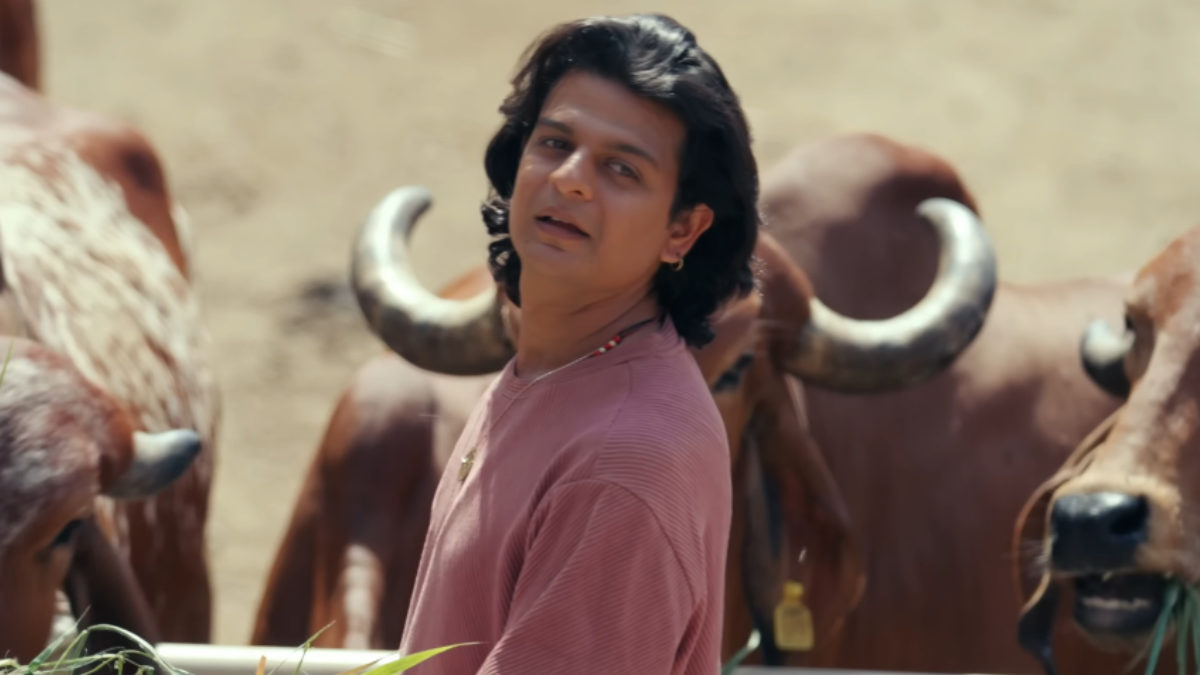
In an era where cinema often mistakes loudness for depth and exposition for emotion, Laalo – Krishna Sada Sahaayate emerges as an anomaly—almost an act of defiance. Originally released in Gujarati on October 10, 2025, and reintroduced to audiences through its Hindi version on January 9, 2026, the film defies not just box-office logic but also conventional cinematic grammar.
Reviewing a film reportedly made on a budget of roughly ₹50 lakh that went on to collect close to ₹120 crore worldwide almost feels futile. Numbers of this magnitude cease to be about commerce; they point instead to impact—cultural, emotional, and spiritual. Laalo is not a film that chased an audience. It found one. Quietly. Relentlessly. Through belief, word of mouth, and emotional truth.
At its narrative core is Laalo, a rickshaw driver burdened by debt, fractured relationships, and a gnawing sense of personal failure. Circumstances leave him stranded in an abandoned farmhouse—an outwardly simple plot device that soon reveals itself as a deeply symbolic space. This is not merely a physical trap, but a psychological one, where Laalo is forced to confront memories he has long avoided.
What makes the film extraordinary is how it handles the presence of Lord Krishna. Krishna is never announced, never dramatized, never turned into spectacle. There are no thunderous cues or moral lectures. Instead, Krishna exists as a presence—almost conversational, sometimes playful, sometimes silent—like a companion who appears when all other voices have faded. The film understands something profoundly human about faith: that belief does not arrive with noise, but with reassurance.
One of the most striking and deliberate choices in Laalo lies in its visual and performative discipline. The director makes a conscious decision to ensure that actors never “speak to the camera”—a habit that plagues much of conventional cinema, where characters often emote at the lens, inadvertently reminding the viewer that they are watching a performance. Here, that artificiality is completely stripped away. Characters speak to spaces, to silences, to each other, and sometimes to themselves—but never to the audience.
This choice is critical. It allows emotion to feel organic rather than performed. There is no sense of actors “delivering moments.” Instead, moments simply unfold. The result is an immersive realism where the viewer feels like an observer rather than a spectator being addressed.
The camera, too, adheres to this philosophy with remarkable consistency. There is not a single frame that exists merely for aesthetic value. Every shot communicates something—an emotion, a hesitation, a shift in mental state. The environment is never decorative; it is participatory. Walls close in, open spaces feel isolating, shadows linger longer than comfort allows. The farmhouse doesn’t just house Laalo—it reflects him. The surroundings absorb his despair, echo his confusion, and eventually soften as he does.
This is where the director’s vision becomes unmistakably clear. The visual language refuses to separate character from space. Emotion doesn’t sit solely on faces; it spills into the frame itself. This is a rare achievement, especially in low-budget cinema, where visual storytelling is often compromised. In Laalo, limitation becomes strength. The absence of excess sharpens intent.
Casting further anchors the film’s authenticity. Karan Joshi’s portrayal of Laalo is unforced and deeply internalized. He doesn’t perform suffering; he carries it. His silences are as expressive as his dialogues. The supporting cast blends seamlessly into the narrative, never feeling like “characters” but rather people whose lives briefly intersect with Laalo’s journey. Their believability is essential to the film’s emotional payoff—and it works.
Language plays a subtle but significant role in how the film lands. While the Hindi-dubbed version makes the story accessible to a wider audience, there are moments where the emotional texture of the original Gujarati feels diluted. Certain dialogues lose their cultural cadence and lived-in intimacy. The intent remains intact, but the impact softens. For those who can access it, the original version undoubtedly carries greater weight.
What remains undeniable is the film’s unprecedented word-of-mouth journey. With little to no visible marketing muscle, Laalo relied entirely on audience conviction. People didn’t just recommend the film; they urged others to experience it. That kind of organic advocacy cannot be manufactured—it can only be earned.
For mainstream and conventional filmmakers, Laalo – Krishna Sada Sahaayate should serve as both inspiration and introspection. It challenges long-held assumptions about scale, stars, promotion, and even narrative loudness. It proves that sincerity travels farther than spectacle, and that audiences—often underestimated—can sense honesty when it appears on screen.
Most importantly, the film redefines devotional cinema. Krishna here is not distant or divine in the traditional sense; he is familiar, approachable, almost human. Faith is not imposed—it is invited. You don’t need to be a devotee to connect with Laalo. You only need to have felt lost, guilty, or in need of reassurance at some point in life.
In the end, Laalo – Krishna Sada Sahaayate doesn’t seek applause. It seeks stillness. It sits with you, long after the screen fades to black, reminding you that sometimes the most powerful cinema doesn’t shout—it listens.
Movie: Laalo – Krishna Sada Sahaayate
Directed by: Ankit Sakhiya
Cast: Reeva Rachh, Shruhad Goswami, Karan Joshi, Mishty Kadecha, Anshu Joshi, Kinnal Nayak, Parul Rajyaguru, Jaydeep Timaniya
Theatrical Release dates: October 10, 2025 (Gujarati) January 9, 2026 (Hindi)
Running time: 2hrs 15mins
Laalo – Krishna Sada Sahaayate
3.5