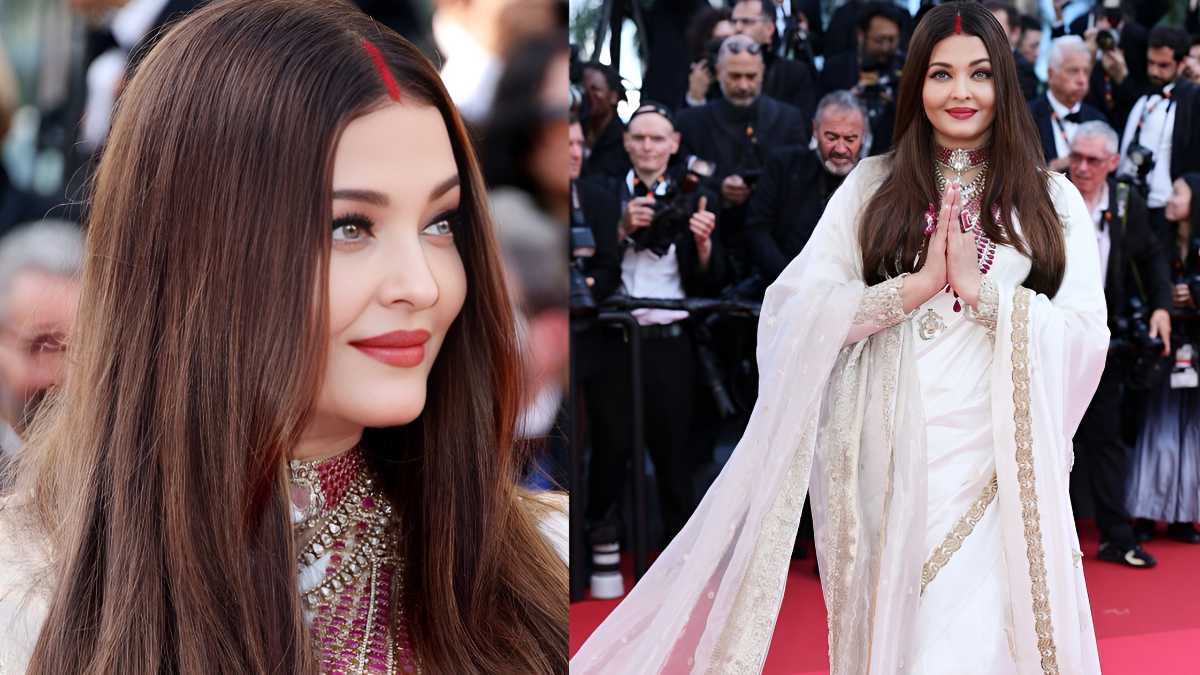
For more than two decades now, Aishwarya Rai Bachchan and Cannes have almost become inseparable in the public imagination. Every year when the Cannes Film Festival begins, one of the first questions in India is not about the films or the jury but whether Aishwarya will walk the red carpet. That itself says something about the kind of presence she has built over the years.
Aishwarya first attended Cannes in 2002 for the screening of Devdas. She arrived in a yellow saree with Shah Rukh Khan and Sanjay Leela Bhansali at a time when Indian actors were still relatively rare on global red carpets. What stood out was that she did not try to blend into Western celebrity culture. She carried her Indian identity very openly through traditional clothing, jewellery and styling. For many Indian viewers, it felt like representation rather than performance.
Since then, she has attended Cannes more than 20 times, making her one of the most regular Indian faces at the festival. Over the years, she has appeared as an actress, jury member and global ambassador for L’Oréal Paris. Her relationship with Cannes slowly moved beyond cinema and became part of fashion culture, luxury branding and celebrity spectacle.
What makes Aishwarya’s Cannes journey interesting is that it mirrors the rise of Bollywood on the global stage. In the early 2000s, Indian cinema was still fighting for international visibility. Cannes was seen as distant and elite. Aishwarya helped close that distance. She became familiar to international photographers and fashion magazines at a time when very few Indian celebrities had that kind of visibility abroad.
Her appearances also changed with time. In the beginning, she leaned heavily into Indian silhouettes and traditional looks. Later came the dramatic gowns, couture labels and experimental makeup choices that made headlines every year. Some of those looks were celebrated and some were criticised, but they were almost never ignored. That ability to remain culturally relevant for such a long period is rare in celebrity culture.
What is also important is that Aishwarya made Cannes feel mainstream in India. Today many Indian actors, influencers and fashion personalities attend the festival, but there was a time when Cannes coverage in Indian media revolved almost entirely around her. She helped turn the red carpet into a moment of national attention.
This year has been especially interesting because her absence during the opening days of Cannes immediately became a major talking point online. Reports and social media discussions questioned whether she would attend at all. The conversation became bigger because audiences are so used to seeing her there every year. Even people who no longer closely follow Bollywood noticed her absence.
There has also been speculation this year around changing dynamics at Cannes, especially with newer stars and brand ambassadors receiving more visibility. In many ways, the discussion around Aishwarya this year is not only about one celebrity attending a festival. It reflects a larger transition in celebrity culture itself. Cannes today is no longer only about cinema stars. It is increasingly shaped by influencers, luxury campaigns and digital visibility.
Yet despite all those changes, Aishwarya still occupies a unique space. For many people, she represents the classic era of Cannes glamour before social media transformed red carpets into content factories. Her appearances carried a sense of occasion because they felt tied to stardom rather than constant online visibility.
That is perhaps why her Cannes presence still matters. It is not only about fashion or photographs anymore. It is about continuity. She represents a generation of Indian celebrity culture that introduced itself to the world slowly, carefully and with a certain mystery that is now becoming rare.
Aishwarya Rai and Cannes: Why her Red Carpet presence matters
A look at Aishwarya Rai Bachchan’s long relationship with Cannes, her appearances over the years, and why her presence matters