
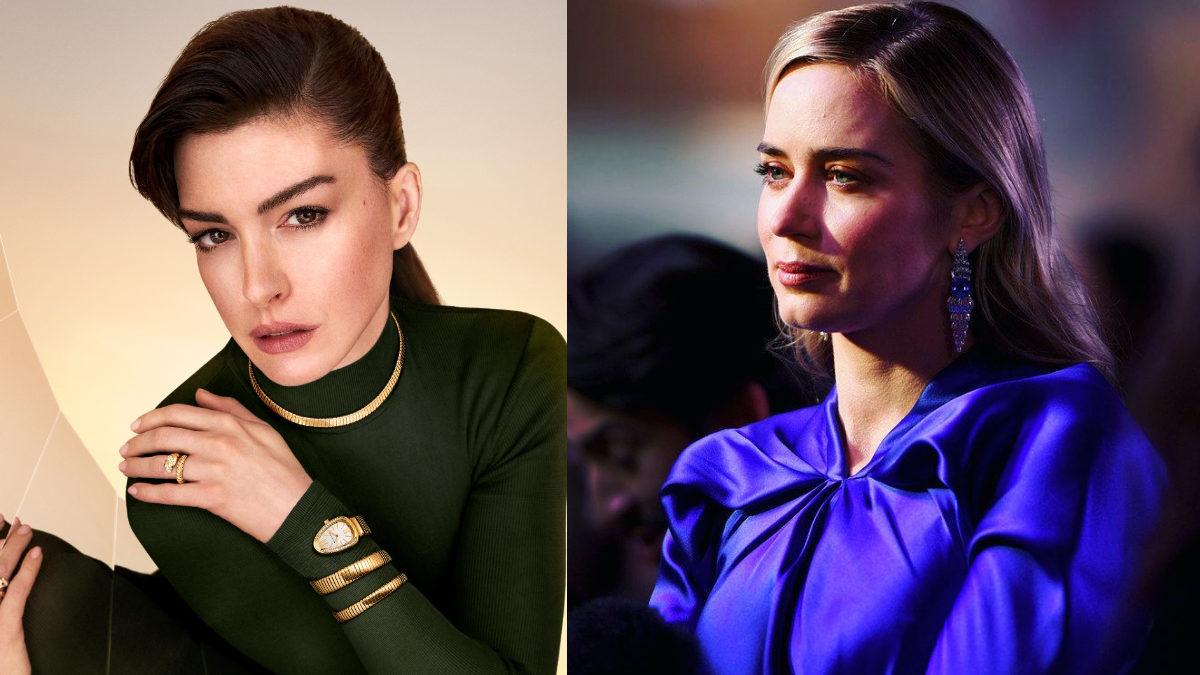
The excitement surrounding The Devil Wears Prada 2 was easy to understand. For many movie lovers, the return of Anne Hathaway and Emily Blunt to the world of Andy Sachs and Emily Charlton felt like revisiting a beloved chapter from the 2000s. But beyond the nostalgia lies a far more fascinating story.
At a time when audiences were celebrating their reunion, both actresses were simultaneously taking on some of the most dramatically different roles of their careers. The contrast is so striking that it serves as a reminder of why Hathaway and Blunt have remained among Hollywood’s most admired performers for nearly two decades.
Consider Anne Hathaway. For an entire generation, she will always be Andy Sachs, the ambitious young journalist trying to survive the impossible demands of Miranda Priestly. Yet the Hathaway audiences are watching today is exploring territory that could not be further removed from that character.
In Mother Mary, she transforms into a globally famous pop star navigating the pressures and emotional scars that accompany celebrity. At nearly the same time, she is stepping into the mythological world of The Odyssey, exploring darker territory through the psychological thriller Verity, and taking on the intimate emotional landscape of The End of Oak Street. Few actors move so comfortably between epic mythology, psychological suspense, music-driven drama and character-focused storytelling.
What makes the transition remarkable is that audiences never seem to question it. Hathaway possesses the rare ability to completely commit to the emotional reality of a character. Whether she is playing a princess, a struggling assistant, an astronaut’s wife, a music icon or a thriller protagonist, she approaches each role with enough conviction that viewers stop seeing Anne Hathaway and start seeing the character.
Emily Blunt’s recent choices are equally impressive. Most fans first fell in love with her sharp wit and impeccable comic timing as Emily Charlton. The character was sarcastic, ambitious and endlessly entertaining. Yet anyone looking at Blunt’s current slate would be hard pressed to find similarities.
In The Smashing Machine, she enters the gritty and emotionally demanding world of professional mixed martial arts. In Disclosure Day, she steps into large-scale science fiction. Then there is A Quiet Place Part III, which returns her to one of modern cinema’s most acclaimed horror franchises, and Walk the Blue Fields, a literary adaptation rooted in human relationships and emotional nuance.
The variety is remarkable. Horror, science fiction, sports drama and literary storytelling rarely demand the same skills, yet Blunt continues to move between them with an ease that makes each transition appear effortless.
Look at their upcoming slates side by side and a pattern emerges. Hathaway is moving between mythology, psychological thrillers, music dramas and intimate character pieces. Blunt is balancing horror, science fiction, sports biopics and literary adaptations. The common thread is not genre but their ability to disappear into each world convincingly.
Perhaps that is what separates truly exceptional actors from merely popular ones.
Many performers spend years trying to escape the roles that made them famous. Hathaway and Blunt never seemed interested in escaping anything. Instead, they simply kept expanding their range until audiences learned to expect the unexpected from them.
One year they might be leading a fashion-world comedy. The next they might be tackling psychological drama, science fiction, biographical storytelling, horror or musical performance. The genres change. The characters change. The worlds change. What remains constant is their ability to make every transformation feel natural.
The timing of The Devil Wears Prada 2 inadvertently highlights this better than any award or career retrospective could. Audiences are revisiting two of their most iconic characters while simultaneously watching the actresses inhabit completely different lives elsewhere on screen.
That balancing act is not easy. It requires technical skill, emotional intelligence and an instinctive understanding of character. More importantly, it requires a willingness to take risks rather than repeat what has worked before.
In an era where typecasting remains one of Hollywood’s biggest challenges, Anne Hathaway and Emily Blunt continue to prove that versatility is still one of the industry’s most valuable superpowers.
Their reunion may have reminded audiences where they came from. Their recent work is a powerful reminder of just how far they have travelled since.
And perhaps that is the most impressive part. Even after all these years, neither actress seems interested in finding a comfortable lane and staying there. Instead, they continue to challenge themselves and, in the process, remind audiences why true movie stars are not defined by a single role but by their ability to become someone entirely different every time the camera starts rolling.