
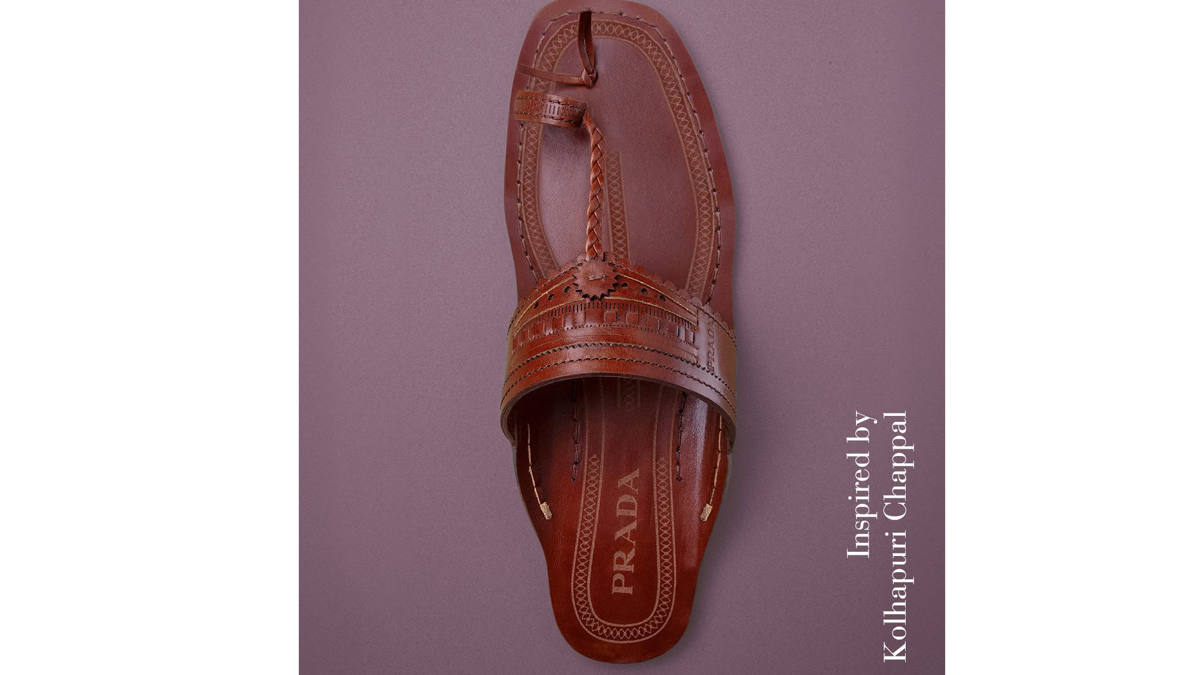
When Prada showcased leather sandals at Milan Fashion Week 2025, what should have been just another luxury runway moment quickly turned into a global controversy. The reason was simple. The sandals looked almost identical to traditional Kolhapuri chappals, a centuries old handcrafted footwear style from Maharashtra and Karnataka. The problem was not just the resemblance. It was the fact that there was no mention of India, no acknowledgment of the craft, and no credit to the artisans behind it.
Kolhapuri chappals are not just a design reference. They are a GI tagged product tied to specific regions and communities that have been making them for generations. Yet, Prada presented the design as generic leather sandals, which immediately triggered backlash across India. Artisans, politicians, and social media users called out the brand for cultural appropriation and for attempting to profit off a traditional craft without recognition.
The outrage was also driven by the stark pricing contrast. Traditional Kolhapuri chappals are widely available in India at a fraction of the cost, often sold in local markets for a few hundred rupees, while Prada’s version was priced at hundreds of euros, pushing it into the luxury bracket. This raised uncomfortable questions about who benefits when traditional designs are repackaged and sold globally.
Facing mounting criticism, Prada was forced to respond. The brand acknowledged that its designs were inspired by Kolhapuri chappals and began engaging with Indian stakeholders. Discussions were held with the Maharashtra Chamber of Commerce and artisan groups, marking a clear shift from the initial silence.
What followed was a visible attempt to reposition the narrative. Prada announced a limited edition “Made in India” sandal collection, produced in collaboration with artisan bodies in Maharashtra and Karnataka. The company also introduced a three year training program aimed at working with around 180 artisans from traditional Kolhapuri making districts, along with opportunities to engage with Prada’s design ecosystem.
Alongside this, the brand began releasing images and videos highlighting Indian craftsmen at work, placing the spotlight on the making process that had previously gone unmentioned. Campaign language shifted to include phrases like “Made in India” and references to collaboration with local artisans.
However, even after these steps, one detail continued to stand out. Prada consistently described the designs as “inspired by Kolhapuri chappals.” For many critics, this wording remained at the center of the issue. The design itself showed minimal deviation from the original, leading to a broader debate about where inspiration ends and imitation begins.
The timing of Prada’s response has also been widely discussed. The acknowledgment of Indian craftsmanship, the partnerships, and the storytelling all came after the backlash had already escalated. This sequence has led many to view the brand’s actions less as proactive cultural appreciation and more as reactive damage control.
At its core, the controversy is not just about one pair of sandals. It highlights a larger tension within global fashion. Luxury brands often draw from traditional crafts across the world, but attribution, compensation, and visibility for the original creators do not always follow at the same pace.
Prada’s Kolhapuri episode has therefore become a case study in how cultural exchange can go wrong when acknowledgement is delayed. It also shows how quickly audiences today can hold global brands accountable, pushing them to rethink not just their designs, but also their narratives.
The bigger question that remains is simple. Should recognition come only after backlash, or should it be built into the story from the very beginning.