
Every generation discovers its own Ramayana. That is perhaps the biggest challenge and also the greatest responsibility before Nitesh Tiwari’s Ramayana. It is not making a film for an audience that has never heard the story. It is making a film for an audience that knows the names but may not truly know the characters.
For millions, the Ramayana is not merely mythology. It is memory. It has been narrated by grandparents, celebrated through festivals, performed on stage, adapted for television and revisited through countless books. The story itself has never been in danger of being forgotten.
What has changed, however, is the way younger audiences consume stories.
Many among today’s generation know the broad episodes of the epic. They know that Lord Ram was exiled, that Sita was abducted, that Hanuman crossed the ocean and that Ravana was defeated. Yet the emotional journey between these milestones is often unfamiliar. The moral dilemmas, the relationships, the sacrifices and the philosophies that give the Ramayana its timeless relevance are not always deeply understood. Many have also not connected with earlier screen adaptations that defined previous generations.
Perhaps that is where Nitesh Tiwari’s vision finds its purpose.
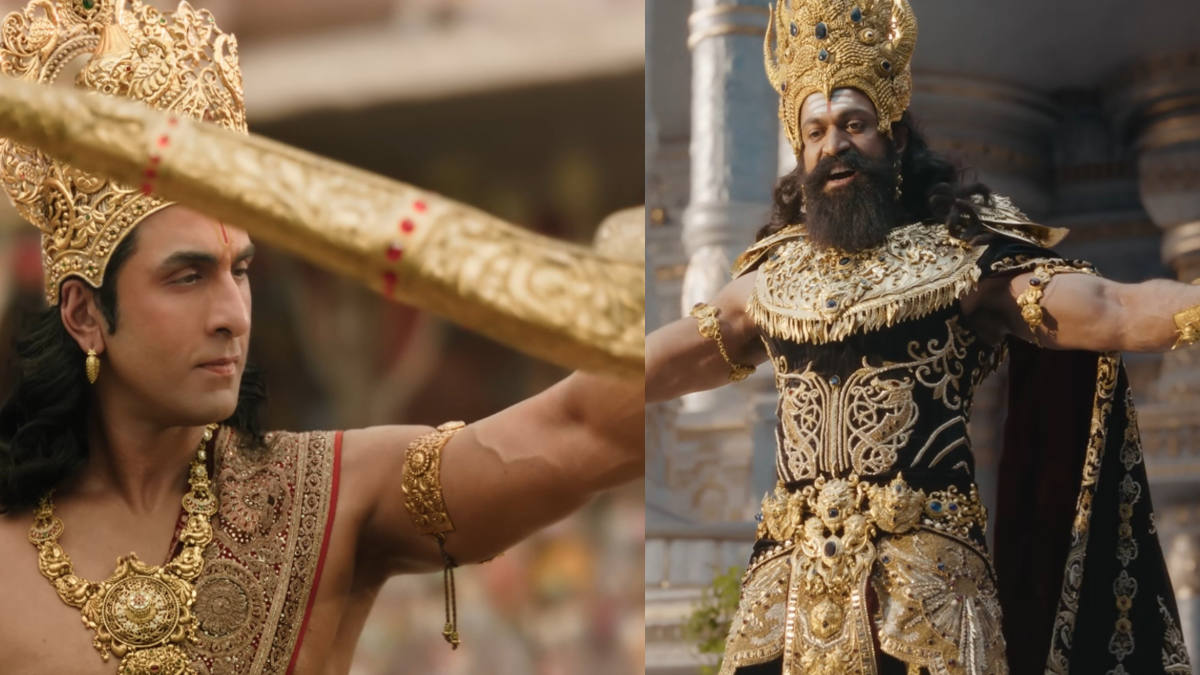
Judging purely by the trailer, the attempt appears to be less about retelling the Ramayana and more about reintroducing it in a cinematic language that today’s audience instinctively understands. The emphasis is clearly on scale, visual grandeur and immersive world building. It seems designed to make younger viewers experience the epic with the same sense of awe that earlier generations felt while watching their defining adaptations.
At the same time, the trailer also raises an interesting question. Can visual spectacle alone carry an epic whose greatest strength has always been its emotional and spiritual depth?
The first glimpse suggests that several key characters are being introduced through their visual identities before their inner qualities. Yash’s Ravana makes an undeniably striking entrance. The surrounding grandeur, the staging and his commanding screen presence instantly establish him as a formidable force. The trailer succeeds in making audiences want to see more of him. Yet the dialogues accompanying that presence stop short of becoming instantly memorable or legendary in the way audiences often expect from such an iconic character.
A similar observation applies to Ranbir Kapoor’s Lord Ram. Fans of the actor are likely to embrace his interpretation with an open mind. But audiences who grew up with earlier portrayals inevitably carry a different emotional benchmark. For many, Lord Ram has long been associated with a serene smile, quiet compassion and unwavering composure. Those qualities became deeply embedded in public imagination through earlier interpretations. Whether this newer, more restrained portrayal ultimately captures that timeless grace is something only the complete film can answer.
This, however, is not necessarily a criticism. Every generation deserves the freedom to reinterpret timeless literature. Shakespeare has been adapted across cultures and centuries. Greek mythology has been reinvented repeatedly. Even global fantasy franchises constantly evolve with changing filmmaking techniques and audience sensibilities. The Ramayana too cannot remain frozen in one visual language forever if it wishes to continue speaking to newer audiences.
The real test is whether technology serves the story rather than replacing it.
Modern visual effects can create breathtaking kingdoms, larger than life battles and mythical creatures with unprecedented realism. They can transport audiences into worlds that earlier filmmakers could only imagine. But no amount of computer generated imagery can substitute the emotional power of Ram’s righteousness, Sita’s resilience, Lakshman’s devotion, Hanuman’s unwavering faith or even Ravana’s tragic complexity. The Ramayana has survived for thousands of years because of its characters and values, not because of spectacle.
The trailer understandably prioritises moments that generate excitement. Marketing a film today demands visual hooks that instantly travel across social media and capture shrinking attention spans. Trailers are rarely designed to reveal emotional depth. That responsibility belongs to the film itself.
Perhaps that is why it would be premature to judge this adaptation entirely through a few minutes of footage. The trailer has done what it was expected to do. It has sparked conversation, curiosity and debate across generations. It has also reminded audiences that every adaptation of the Ramayana carries impossible expectations because everyone already has their own version of these characters in their hearts.
In the end, comparisons with beloved interpretations are inevitable. They should also be welcomed. They are a testament to how deeply the epic lives within Indian culture. But each new filmmaker also deserves the opportunity to present the story through the lens of his own generation.
As someone who has grown up with earlier portrayals, I naturally carry those memories while watching this new version. Yet I also recognise that today’s children and teenagers deserve a Ramayana they can call their own.
If Nitesh Tiwari’s film succeeds in encouraging even one young viewer to look beyond the spectacle and discover the timeless values, emotional richness and philosophical depth of the original epic, it will have achieved something far more meaningful than simply becoming another visual blockbuster.
For now, the hope remains simple. May this Ramayana emerge not merely as the biggest adaptation of the epic, but as one of its finest cinematic interpretations, succeeding where many ambitious attempts over the past few decades have struggled.