
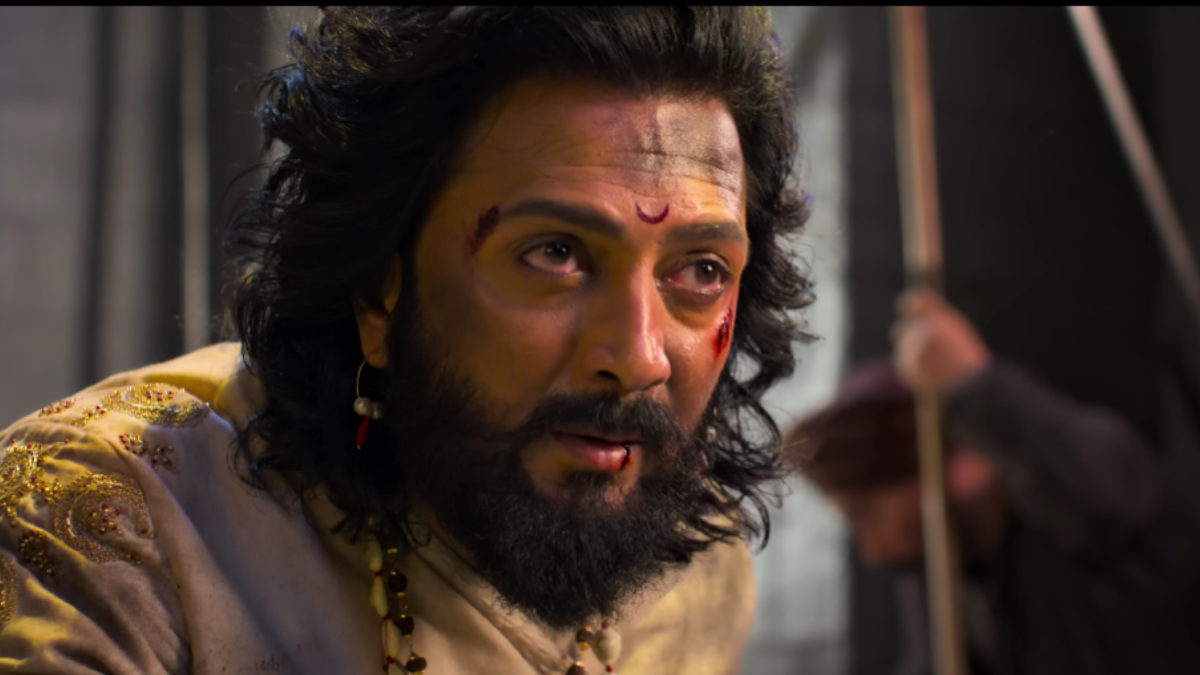
For years, Riteish Deshmukh has been the face of easy laughter in Hindi cinema. Whether it was the chaos of Housefull or the cult humour of Masti, audiences have come to expect a certain lightness from him. A performer who does not take himself too seriously, who slips into comic timing with natural ease, and who often becomes the emotional cushion in ensemble films. That image has stayed strong for nearly two decades.
So when he steps into something like Raja Shivaji, the shift is not just noticeable, it is almost disruptive.
This is not the first time he has broken away from comedy. His performance in Ek Villain was a clear reminder that beneath the humour lies a deeply controlled actor capable of menace and emotional weight. But even that film felt like an exception. Comedy remained his dominant identity in the public imagination.
Raja Shivaji, however, is a different kind of departure. It is not just about playing a serious role. It is about stepping into the legacy of Chhatrapati Shivaji Maharaj, a figure who carries immense historical, cultural and emotional significance, especially in Maharashtra. This is where the contrast becomes sharper. An actor known for playful energy now shoulders a character built on authority, vision, restraint and leadership.
What makes this transition interesting is not just the casting, but the timing. In recent years, there has been a visible trend in Indian cinema where actors consciously attempt to break their typecasting. Some succeed, some feel forced. Riteish’s shift appears more calculated than impulsive. He has slowly built credibility outside comedy through selective roles, including his Marathi directorial venture Ved, which showed a more emotionally grounded side of him.
The audience perception, however, is slower to change than an actor’s choices. For many viewers, Riteish still carries the memory of comic chaos, exaggerated expressions and self-aware humour. That baggage can become both a challenge and an advantage. If he succeeds in Raja Shivaji, the impact will be stronger precisely because expectations were so different.
There is also a deeper layer to this shift. Portraying Shivaji Maharaj is not just an acting challenge, it is a responsibility. The portrayal demands authenticity in body language, speech, and emotional depth. It requires the actor to disappear into history rather than reinterpret it casually. For someone like Riteish, who has largely operated in contemporary and comedic spaces, this means rebuilding his screen presence from the ground up.
Yet, that very distance from the expected mould could work in his favour. Audiences often respond strongly when an actor surprises them. The unfamiliarity forces viewers to engage more actively, to reassess what they think they know about the performer.
This is where the “diametrically opposite” nature of the role becomes important. It is not just about proving versatility. It is about redefining identity. If Raja Shivaji works, it could shift Riteish Deshmukh from being seen as a dependable comic actor to a more complete performer who can move between extremes without losing credibility.
At its core, this transition raises a larger question about how we, as audiences, limit actors. We often reward consistency but hesitate to accept change. Riteish’s move challenges that instinct. It asks whether we are ready to see him not as the man who makes us laugh, but as someone who can command silence, intensity and respect on screen.
And perhaps that is the real story here. Not just an actor changing roles, but an image being rewritten in real time.