
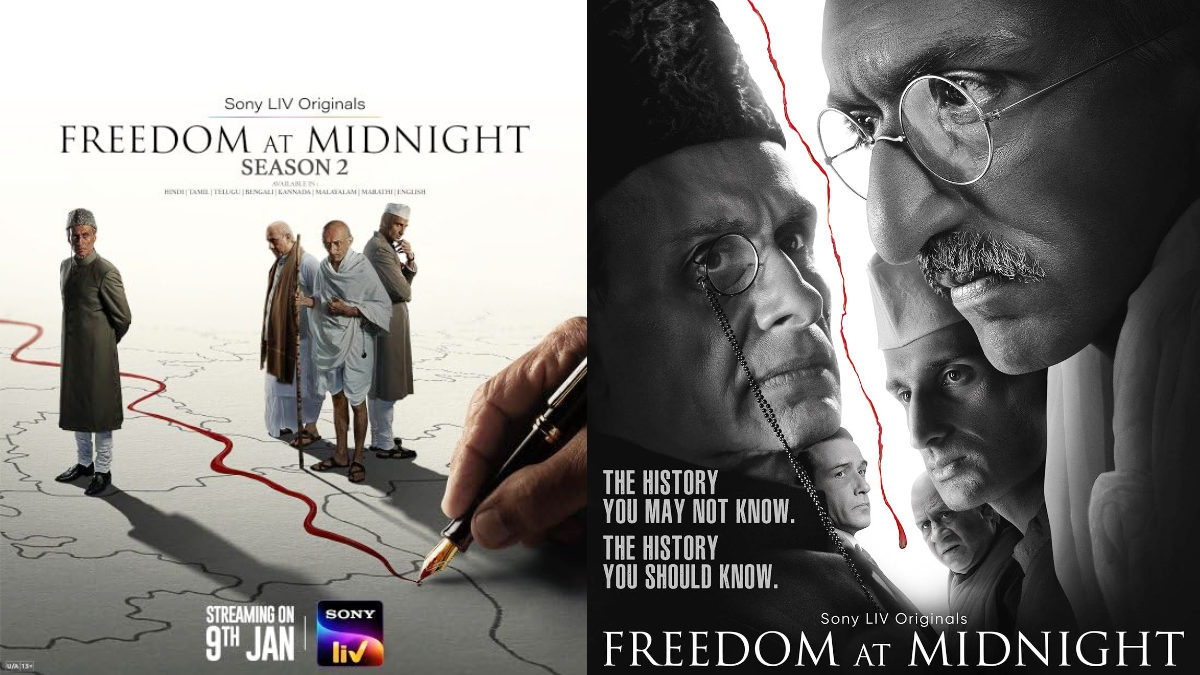
Freedom at Midnight arrives with the burden of history and the responsibility of restraint. Adapted from the extensively researched book Freedom at Midnight by Larry Collins and Dominique Lapierre, the series does not set out to dramatize India’s freedom struggle in familiar heroic strokes. Instead, it turns its gaze to the more uneasy and morally complex moment when freedom had already been secured, but its achievement now had to be managed, executed, and lived with.
The narrative resists the temptation of spectacle. What unfolds is not a plotted drama but a careful reconstruction of events, rooted in documentation and testimony. The source material, long regarded as one of the most authoritative accounts of Independence and Partition, drew from a wide range of Indian, British, and Pakistani perspectives. That balance is preserved here. The series refuses neat conclusions, choosing instead to let history speak through consequence rather than commentary.
As the episodes progress, the focus shifts from resistance to responsibility. Leaders who once stood united against colonial rule are now tasked with governing a fractured land. Ideals are tested by urgency, and personal conviction collides with political necessity. The series observes this transformation without moral grandstanding, allowing viewers to see how freedom fighters gradually assume the roles of leaders and, inevitably, politicians. The cost of that evolution is borne not by those making decisions, but by the millions whose lives are reshaped by them.
The performances mirror this restraint. Sidhant Gupta portrays Jawaharlal Nehru with a mix of vision and vulnerability, while Chirag Vohra’s Mahatma Gandhi is defined by moral clarity increasingly isolated by political reality. Arif Zakaria brings controlled resolve to Muhammad Ali Jinnah, and Luke McGibney captures the unease of imperial authority in Lord Mountbatten. None of these portrayals seek dramatized heroism; they function instead as human studies shaped by pressure.
A notable and quietly powerful presence is Rajendra Chawla as Sardar Vallabhbhai Patel. His portrayal emphasizes inner strength rather than overt force. The character is shown navigating complex situations with firmness and restraint, exercising authority without imposing it until he believes it absolutely necessary. Even then, the series preserves the integrity of his relationships with fellow freedom fighters, underscoring a leadership style grounded in resolve rather than dominance. Chawla delivers the role with conviction, allowing Patel’s steadiness and pragmatism to register without theatrical emphasis.
One of the most devastating threads running through the series is the treatment of displacement. The word “refugee” lands with particular cruelty. People who had lived their entire lives in undivided India, who had participated equally in the freedom movement, are suddenly rendered outsiders purely on the basis of religion. The tragedy is not only in the violence and loss, but in the language itself. To call them refugees is to strip them of belonging, a wound that remains deeply unsettling even today.
The series inevitably invites difficult questions. Could this suffering have been anticipated? Could the transition have been communicated with greater humanity, even if separation was unavoidable? Freedom at Midnight does not attempt to answer these questions. It simply shows what happened, and in doing so, reminds us that politics rarely changes its nature. Ego, fear, and aspiration continue to shape history, often with irreversible consequences.
For viewers born into independent India, the series carries a particular emotional weight. Freedom is inherited, its cost often abstract. Watching these events unfold is a reminder that independence was not a singular moment of triumph but a prolonged period of uncertainty, compromise, and grief. Each character responds differently to the turning of history, and none emerge untouched.
In the end, Freedom at Midnight succeeds because it refuses comfort. It does not tell viewers what to think, nor does it attempt to soften the harm already done. It stands as a measured, deeply affecting account of a nation finding its footing amid chaos. This is not a celebration of freedom, but an examination of its price, and for that reason alone, it remains essential viewing, wherever one may live.
Series: Freedom at Midnight
Created by: Nikkhil Advani
Based on: Freedom at Midnight by Dominique Lapierre and Larry Collins
Featuring: Sidhant Gupta, Chirag Vohra, Rajendra Chawla, Luke McGibney, Arif Zakaria, Pawan Chopra, Ira Dubey, Rajesh Kumar, K.C. Shankar, Richard Teverson, Richard Teverson, Kaizaad Kotwal, Anurag Thakur, Abhishek Banerjee
Seasons: 2
Episodes: 14 (~37–48 mins each)
Streaming on: SonyLIV
Freedom at Midnight
4