
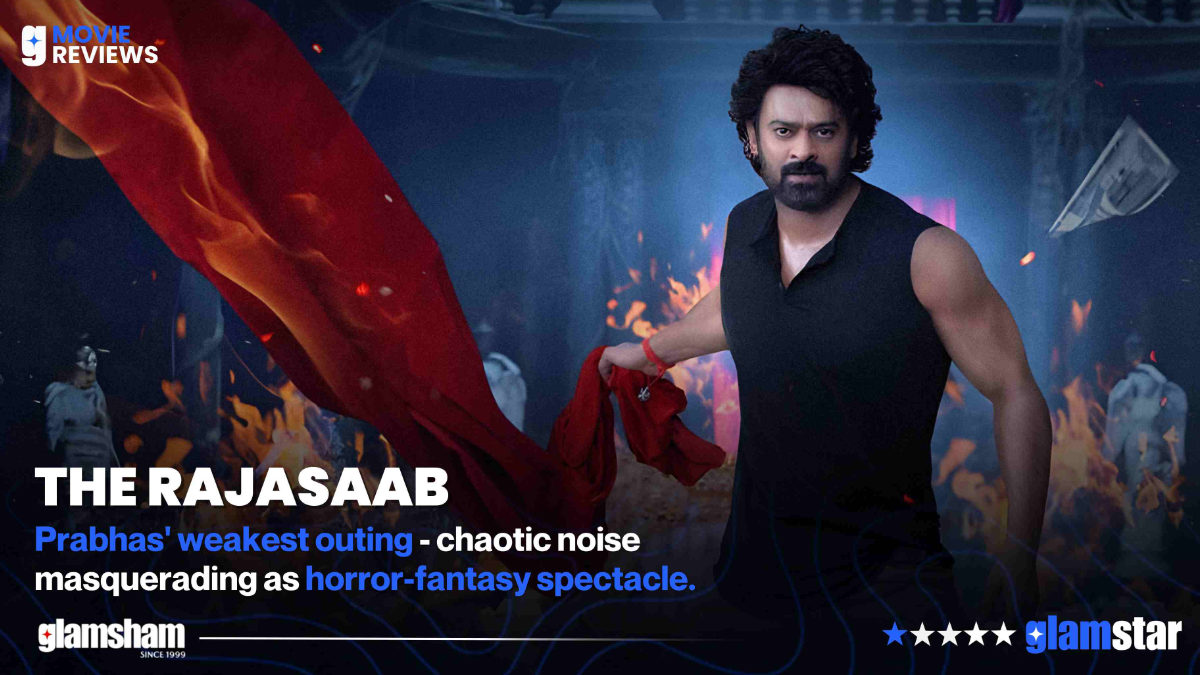
The Raja Saab sets out with a premise that actually sounds serviceable on paper. Prabhas plays Raju, a man emotionally tethered to his ageing grandmother Gangamma / Ganga Devi (Zarina Wahab) and her unresolved past, a past that leads them to a secluded, supposedly haunted mansion hidden deep in a forest. The house carries secrets tied to ancestry, unresolved deaths, supernatural forces and a legacy waiting to be claimed. It’s the kind of setup that could have worked as a restrained horror-fantasy or even a character-driven mystery. Unfortunately, restraint is the one thing this film seems fundamentally allergic to.
I initially assumed the absurdity would peak with the introductory song — a thunderous, self-congratulatory ode reminding us repeatedly that Prabhas is Prabhas — a familiar mass-movie ritual. But as the film progressed, it became painfully clear that the intro song wasn’t the excess, it was the mission statement. Almost everything that follows is drenched in overstatement. Heroism is not earned; it is declared. Logic is not bent; it is casually abandoned. Every situation, no matter how trivial or supernatural, is treated as an excuse for elevation shots, slow motion and a background score that refuses to respect silence. The music is so loud and intrusive that at times it feels like it’s desperately trying to echo the rhythm and flavour of Naatu Naatu, except without the joy, precision or cultural punch. Halfway through the film, I found myself subconsciously wishing it would actually turn into Naatu Naatu, just so my mind could momentarily escape the experience — sarcasm, but also survival instinct.
What makes The Raja Saab particularly disappointing is the context of Prabhas’ own career. This is an actor who became a nationwide phenomenon after Baahubali, and yet here he is anchoring a film that feels creatively careless and overly reliant on his physical presence to paper over weak writing. It’s difficult not to speculate whether this explains his visible absense around promotions, because once you’ve seen the final product, hesitation feels less like indifference and more like self-preservation. Stardom can draw crowds, but it cannot compensate for a narrative that seems unsure of what it wants to be from one scene to the next.
One of the more baffling creative choices involves Bessy (Nidhhi Agerwal) introduced in a nun’s attire, shown once playing a confessor — a role traditionally associated with priests — only to be positioned as a romantic interest for the hero. When this predictably raises eyebrows, the makers later clarify that she isn’t actually a nun but a postulant, a clarification that feels less like layered character writing and more like after-the-fact damage control. It’s symptomatic of the film’s approach overall – provoke first, explain later, if at all.
The mansion, meant to be a site of dread and isolation, unintentionally becomes a fashion parade. Characters trapped deep in a forest with supernatural threats somehow manage to appear in freshly styled outfits in every scene and applying body lotion as if they are out on a picnic. This isn’t cinematic liberty or visual flourish; it’s a complete collapse of immersion, driven by the need to present actors as marketable visuals rather than believable participants in the story. When survival situations come with costume changes, tension evaporates.
Given how heavily the film leans into the supernatural, the visual effects should have been its strongest pillar. Instead, they are among its weakest. The VFX often look unfinished, obvious, and what should have been eerie or grand frequently slips into unintentionally cartoonish territory. When spectacle dominates the runtime and even that spectacle feels unconvincing, the film leaves itself with very little to stand on.
South Indian mass cinema has often stretched logic to amplify emotion or ideology, but The Raja Saab stretches everything — tone, genre, sound, spectacle — until coherence snaps. Horror, comedy, romance, fantasy and hero worship collide without rhythm or balance. Scenes don’t organically evolve; they simply arrive, announce themselves loudly and move on. And just when you think the film has exhausted its supply of misjudged choices, it ends by teasing a sequel titled ‘RajaSaab 2: Circus 1935’, a moment that feels less like franchise ambition and more like a prank played on a patient audience. One can only hope the title is ironic, because if this is the creative direction, calling it a circus might actually be the most honest thing about it.
For viewers who discovered Prabhas post-Baahubali, The Raja Saab could very well register as his weakest theatrical outing so far — a film that mistakes noise for scale, repetition for impact and blind hero worship for storytelling. Mass cinema thrives on conviction and craft; The Raja Saab mostly offers chaos, wrapped in volume, and sold as spectacle.
Movie: The RajaSaab
Directed by: Maruthi
Featuring: Prabhas, Sanjay Dutt, Zarina Wahab, Boman Irani, Malavika Mohanan, Nidhhi Agerwal, Riddhi Kumar
Theatrical Release date: 9 January 2026
Running Time: 3hrs 9mins
Primary Language: Telugu
The Raja Saab
1