
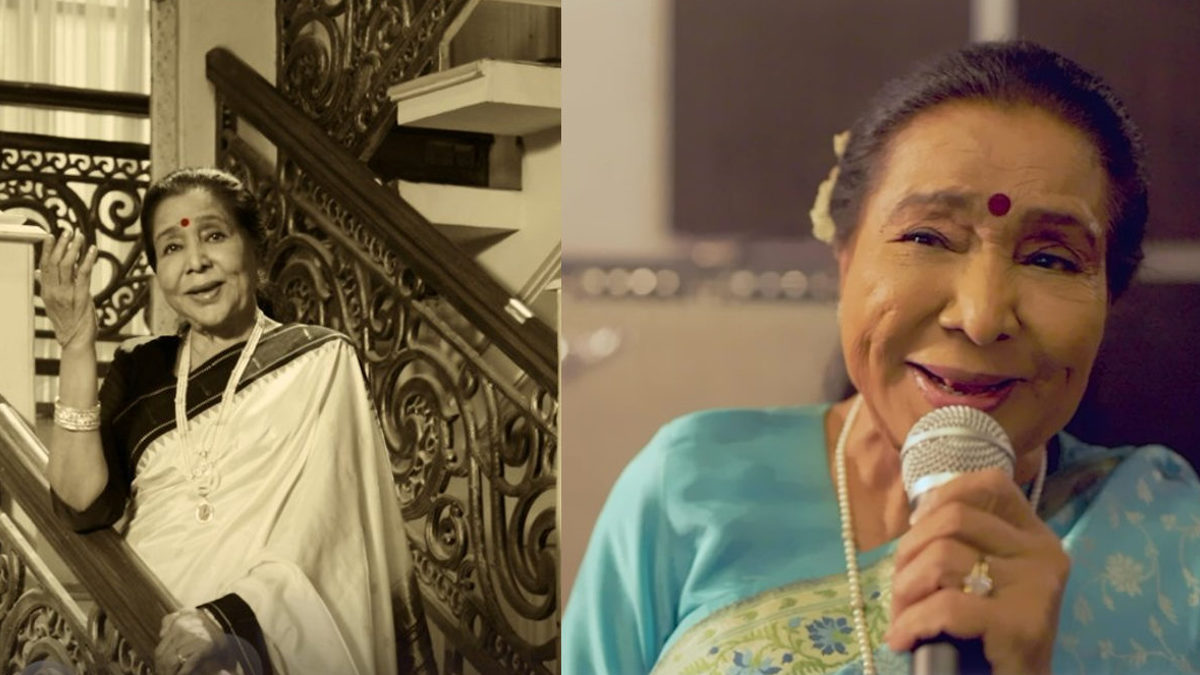
In evaluating the cultural history of Hindi film music, certain voices transcend their function as playback and evolve into social phenomena. Asha Bhosle is one such voice. For over seven decades, her singing has resonated not merely within the confines of cinema halls, but across social classes, generations, and stylistic transformations, becoming, in many ways, the voice of the hoi polloi. Her music spoke directly to the everyday listener, embodying emotional spontaneity, sensuality, rebellion, and modernity.
My earliest realisation of Asha Bhosle’s cultural embedment comes from a personal memory. During my first visit to my native village in Ghazipur, Uttar Pradesh, my grandfather insisted on picking me up from the local bus stand and walking me through the meandering village roads, over three kilometres, as a way of sharing familial pride. As I alighted from the bus, he stopped me. A paan shop nearby blared “पान खाए सैंया हमार” from a radio. Tape recorders had only recently entered rural markets, and the shopkeeper was playing the song on loop.
My grandfather, visibly absorbed, sat listening for nearly half an hour. When I asked what captivated him so completely, he replied that the voice carried the aroma of petrichor, a reminder of soil, rain, and the lived textures of rural life. He explained that he had bought a radio solely to seek out that voice, constantly tuning frequencies in search of her songs. When I asked the singer’s name, he responded with quiet pride: Asha Bhosle.
This anecdote is not exceptional; it reflects a broader truth. For listeners like my grandfather, and for millions since her debut in the 1940s and ever-expanding, especially post Dhurandhar, Asha Bhosle’s voice became synonymous with emotional release. Hers was the voice people returned to when they wished to abandon restraint. Few singers have managed to remain relevant across such a long arc of cinematic and musical history. From the black and white introspection of “Na to karvan ki talash hai” to later reinterpretations in popular culture such as “Monica, Oh My Darling”, Asha Bhosle’s tonal signature forms a connective tissue across eras. No wonder Dhurandhar, arguably one of the most ambitious films on Hindi cinema could not remain aloof to the intoxicating reach of Asha Bhosle’s voice and used it in different formats for the storyline in the movie.
Asha Bhosle occupies a singular position in global music history. She is perhaps the only major vocalist to have actively participated in every technological and stylistic transition of popular music, from acoustic orchestration and classical structures to electronic synthesis, disco, club music, and remix culture. Yet, despite this constant adaptation, her voice never lost its integrity. This continuity is what allowed her to lend authenticity to widely divergent musical idioms.
This quality explains why Naushad, himself steeped in the Lucknow gharana aesthetic, selected Asha Bhosle for the tawaif numbers in Dharam Kanta (1982), after a prolonged hiatus from filmmaking. He famously remarked that her voice retained bazaaroopan, the lived resonance of kothas and courtesan spaces. A similar sentiment was echoed by O.P. Nayyar during his later career. Such observations place Asha Bhosle at the crossroads of folk, classical, and popular expression.
In 2006, WorldSpace Radio curated a list of ten all-time great Hindi film songs based on inputs from legendary music directors. “Dil Cheez Kya Hai” from Umrao Jaan found a distinguished place on that list. Indeed, the film’s enduring status owes much to Asha Bhosle’s rendering, which not only elevated the narrative but also revitalised Khayyam’s career. It is reasonable to suggest that in any catalogue of courtesan themed songs in Hindi cinema, Asha Bhosle’s contributions would far surpass those of any other singer.
Her vocal appeal operates much like the metaphor used in Chandni (1989), where the character observes that cognac is not merely alcohol, it intoxicates subtly. In the same way, Asha Bhosle’s songs do not overwhelm instantly; two or three listens are often sufficient for complete absorption. The listener is gradually bewitched by the phrasing, modulation, and emotional cadence.
Asha Bhosle’s early career unfolded amid formidable competition from legends such as Geeta Dutt, Shamshad Begum, Suraiya, and her elder sister Lata Mangeshkar. She emerged decisively when Geeta Dutt’s career became sporadic due to personal struggles. The critical turning point came with O.P. Nayyar’s CID (1956), where songs like “Leke Pehla Pyar” established her as a confident and distinctive presence, despite sharing space with other stalwarts on the same soundtrack.
Initially typecast as the voice of the common woman rather than the heroine, Asha Bhosle subverted this limitation with Kashmir Ki Kali (1964). Her playback for Sharmila Tagore reshaped her image, prompting the actress, decades later, to pen a heartfelt tribute acknowledging the singer’s defining contribution to her screen persona on the eve of passing away of Asha Bhosle.
While O.P. Nayyar provided early direction, it was Asha Bhosle’s collaboration with Rahul Dev Burman (Pancham da), that marked the true flowering of her artistry. The 1960s and 1970s saw her become the primary voice of generational defiance and cosmopolitan modernity. “Dum Maro Dum” (Hare Rama Hare Krishna, 1971) remains a landmark, often described as Hindi cinema’s first Woodstock-inspired song. Earlier compositions such as “O Haseena Zulfonwali” (Teesri Manzil, 1966) foreshadowed this aesthetic shift.
Perhaps her most distinctive contribution was her ability to infuse sensuality into song without vulgarity. From “Aaiye Meherbaan” (Howrah Bridge, 1958) to “Piya Tu Ab To Aaja” (Caravan, 1971) and “Yeh Mera Dil” (Don, 1978), her voice articulated desire with subtle command. One could argue that performers such as Helen and Aruna Irani owed much of their career longevity to Asha Bhosle’s vocal mediation.
When remix culture faced widespread criticism, Asha Bhosle lent it legitimacy by participating directly, often reinterpreting Pancham’s original compositions. While cautioning younger audiences to engage with original works, her involvement ensured stylistic continuity rather than rupture.
Although Pancham often reserved introspective Gulzar compositions for Lata Mangeshkar, Asha Bhosle crossed this boundary with Dil Padosi Hai and later Ijaazat (1987). Songs like “Chhoti Si Kahani Se” and “Katra Katra”, employing overlapping vocal structures, represent a mature synthesis of lyric, composition, and voice. Introduced experimentally in Jewel Thief (1967), this technique reached perfection in Ijaazat.
Her classical grounding was equally compelling, as evident in “Ab Ke Baras Bhejo Bhaiya Ko Babul” (Bandini, 1963), a rendition reported to have moved Sachin Dev Burman to tears. The vocal jugalbandi between the sisters in “Man Kyun Behka” (Utsav, 1984) stands as the apogee of dual voice performance in Hindi cinema.
Asha Bhosle continued to reinvent herself even while Lata Mangeshkar remained active. Her collaboration with A.R. Rahman in Rangeela (1995) marked a stylistic departure, coinciding symbolically with Rahman receiving the R.D. Burman Award, instituted that year in Pancham’s memory.
Having begun singing at the age of ten, Asha Bhosle celebrated her 90th birthday with a Broadway style musical, an unprecedented feat. Though her playback work became selective, her stage performances retained the vitality and rhythmic command that defined her prime.
Asha Bhosle is not merely a voice preserved in recordings; she is a continuing cultural presence, intoxicating, evocative, and enduring, and while her physical self may have vanished into the ether, her voice would continue to tingle and kindle the hope about life, the ASHA.