
Watching a Steven Spielberg film with extraterrestrial life at its core comes with a certain set of expectations. For decades, Spielberg has approached the idea of life beyond Earth not with horror but with curiosity, wonder and a deep belief in human connection. Disclosure Day continues that tradition, though this time through the lens of government secrecy, public fear and a world standing dangerously close to destroying itself.
Set in 2026 with the world on the brink of World War III, the film follows Daniel Kellner (Josh O’Connor), a cybersecurity specialist who whisks away classified files and extraterrestrial technology from Wardex, a covert arm of the U.S. government headed by Noah Scanlon (Colin Firth). The files reveal decades of hidden human-alien contact dating back to the Roswell incident. Once the theft is discovered, Daniel is branded a foreign spy and forced into hiding alongside his girlfriend Jane Blankenship (Eve Hewson).
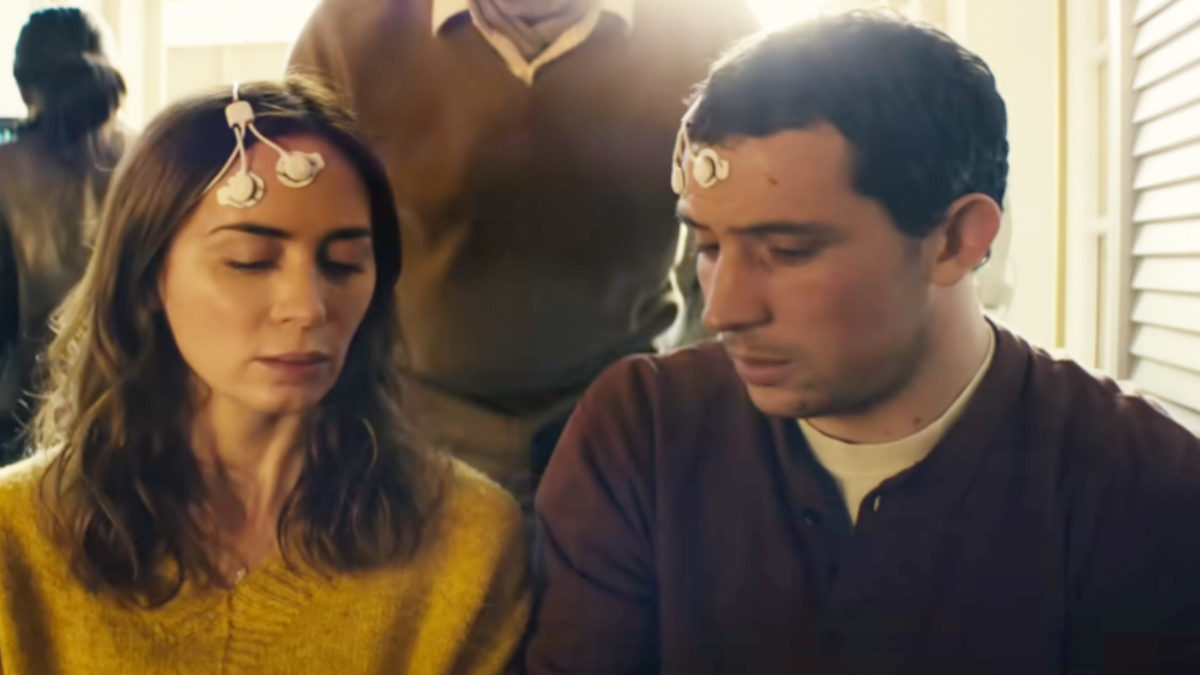
At the same time, in Kansas City, television meteorologist Margaret Fairchild (Emily Blunt) begins experiencing strange phenomena after an encounter involving a cardinal. What initially appears to be an isolated incident soon develops into something far more profound. Margaret starts understanding the emotions and thoughts of those around her and unconsciously speaks in an extraterrestrial language during a live broadcast. The footage goes viral, drawing the attention of Wardex and setting her on a collision course with Daniel’s mission.
The narrative gradually expands into a globe-spanning conspiracy involving alien captives, reverse-engineered technology and decades of carefully guarded secrets. Along the way, the film introduces Hugo Wakefield (Colman Domingo), a Wardex defector who believes humanity deserves to know the truth. Together, Daniel, Margaret and a group of whistleblowers move toward what they call “Disclosure Day”, a global broadcast intended to reveal evidence of extraterrestrial contact and the cover-ups that followed.
As a science-fiction thriller, the film delivers the expected Spielberg spectacle. There are tense chases, large-scale action sequences and a spectacular train sequence that delivers the kind of visual wonder audiences expect from Spielberg. Yet the film’s real strength lies elsewhere. Beneath the conspiracy and suspense is a surprisingly thoughtful conversation about fear itself.
One of the film’s most striking moments arrives through a conversation involving Sister Maura, a nun played by Elizabeth Marvel, who poses a simple yet profound question. Why would God create a universe so unimaginably vast if life existed only on Earth? In a film filled with conspiracies, whistleblowers and extraterrestrial mysteries, its most thought-provoking moment may simply be a nun questioning humanity’s assumption that it is alone in the cosmos. The scene quietly challenges the notion that spirituality and extraterrestrial life are somehow incompatible. Instead, it suggests that the possibility of life beyond our planet may be entirely consistent with faith. The idea is neither treated as blasphemous nor revolutionary. Rather, it is presented as a natural extension of wonder about creation itself.
That conversation becomes the philosophical backbone of Disclosure Day. The film repeatedly asks what exactly humanity is afraid of. If extraterrestrials have visited Earth, what evidence exists that they came with the intention to destroy us? Why does the possibility of another intelligent civilization automatically trigger fear rather than curiosity?
The film proposes a different perspective. If a civilization possesses the ability to traverse the vast distances of space and reach Earth, then it is almost certainly far ahead of humanity technologically. Instead of viewing that as a threat, perhaps it could be viewed as an opportunity. An opportunity to learn, to exchange knowledge and to understand our place in a much larger universe. The idea is not that humanity should blindly trust the unknown, but that fear should not be the default response to it.
What makes the film particularly interesting is that it avoids reducing its conflict to a battle between good and evil. Noah Scanlon and the forces trying to suppress the truth are not portrayed as villains. Their actions are rooted not in malice but in uncertainty. They genuinely believe disclosure could create chaos, panic and global instability. On the other side, Daniel, Margaret and the whistleblowers believe secrecy itself has become the greater danger. Neither side is acting without reason. The conflict emerges because both are responding to uncertainty in different ways.
This theme becomes increasingly apparent as the story unfolds. The film suggests that many acts of aggression are ultimately defensive reactions to fear. People fear what they do not understand. Governments fear losing control. Institutions fear disorder. Entire societies fear the possibility that long-held beliefs may need to be reconsidered. In Disclosure Day, the offence is often born from defence.
Emily Blunt anchors the film with a performance that balances vulnerability and determination, while Josh O’Connor brings conviction to Daniel’s role as a reluctant whistleblower. Colin Firth lends credibility and complexity to Scanlon, ensuring the character remains understandable even when his actions become increasingly extreme. Colman Domingo adds gravitas as Hugo Wakefield, while Eve Hewson’s Jane serves as an important bridge between the film’s spiritual and emotional ideas.
Spielberg returns to original science fiction with ambition, emotional sincerity and a willingness to engage with larger philosophical questions. While the film occasionally revisits familiar Spielberg territory and does not always perfectly balance its thriller mechanics with its bigger ideas, its sincerity and sense of wonder ensure that its themes linger long after the credits roll.
The climactic broadcast that gives the film its title is less about revealing the existence of extraterrestrials and more about confronting humanity’s relationship with truth itself. In the end, Disclosure Day argues that the unknown does not have to be feared. Sometimes it can be embraced. Sometimes it can become an invitation to grow.
In an age where conspiracy theories, misinformation and global distrust dominate public discourse, Spielberg offers a simple but powerful alternative. Instead of asking what is out there, Disclosure Day asks what is inside us. Are we driven by curiosity or fear? By openness or suspicion? By the desire to learn or the instinct to retreat?
The answer, according to the film, may determine not just how we respond to extraterrestrial life, but whether we are truly prepared for a larger place in the universe.
Movie: Disclosure Day
Directed by: Steven Spielberg
Screenplay by: David Koepp
Story by: Steven Spielberg
Featuring: Emily Blunt, Josh O’Connor, Colin Firth, Eve Hewson, Colman Domingo, Wyatt Russell, Henry Lloyd-Hughes, Elizabeth Marvel, Tommy Martinez
Cinematography: Janusz Kamiński
Edited by: Sarah Broshar
Music by: John Williams
Theatrical Release Date: June 12, 2026
Run Time: 2hrs 25mins
Disclosure Day
3.5