
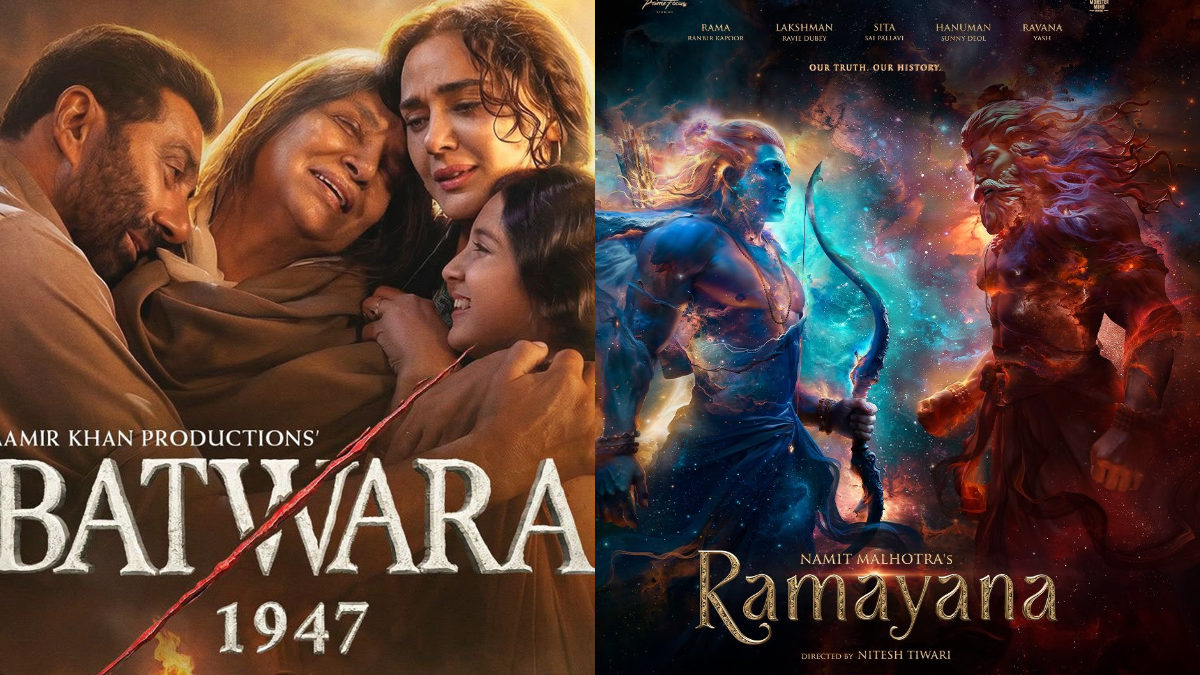
The trailer of Batwara 1947 didn’t make me think about Partition. It made me think about Bollywood. More specifically, it made me wonder whether mainstream Hindi cinema has simply forgotten how to imagine. Before anyone mistakes this as a criticism of one film, let me be clear. Batwara 1947 hasn’t released yet. A trailer is not a film, and it would be unfair to judge Rajkumar Santoshi’s work before audiences have watched it in its entirety.
But trailers are designed to answer one question: Why should I watch this?
And while watching Batwara 1947, I couldn’t shake off another question.
Haven’t we seen this before?
Not this exact story.
This exact playbook.
Partition.
India versus Pakistan.
Hindu versus Muslim.
Loud emotional speeches.
Historical wounds.
Patriotism.
Characters shouting their ideology more than living their lives.
For decades, Bollywood has kept returning to the same emotional well, hoping audiences will continue drawing water from it. The well hasn’t dried up. But audiences have stopped feeling thirsty.
The uncomfortable truth is that Hindi cinema today appears addicted to familiarity. Whenever it wants to make a “serious” film, it instinctively reaches for the same shelf. Partition. Border conflicts. Terrorism. Mythology. Biopics. Sequels. Remakes.
It’s almost as if the industry no longer asks, “What’s the most exciting story we can tell?”
It asks, “What’s the safest story to finance?”
Those are two very different questions. The irony is heartbreaking.
India possesses one of the richest storytelling traditions on the planet. Our folklore, history, literature, science, philosophy and contemporary realities offer limitless possibilities. Yet our biggest cinematic conversations continue revolving around stories whose endings everyone already knows.
Look at what audiences consume today.
A young moviegoer in 2026 doesn’t live inside Bollywood anymore.
They wake up to Korean thrillers.
They binge Japanese anime.
They stream Hollywood science fiction.
They admire Malayalam realism.
They cheer Telugu spectacle.
They discover Tamil filmmakers experimenting with technology, politics and unconventional storytelling.
Every week, they’re watching the world’s most imaginative storytellers compete for their attention.
Then Bollywood asks them to return for another border conflict.
Or another Partition drama.
Or another historical wound.
And wonders why theatres aren’t consistently full.
Hollywood has made hundreds of war films. Yet Saving Private Ryan, Dunkirk, 1917, Inglourious Basterds, Jojo Rabbit and Oppenheimer feel nothing alike. Why?
Because the war is merely the backdrop. The storytelling is the event.
Bollywood often reverses that equation. The backdrop becomes the event. The storytelling becomes secondary.
Perhaps that’s why so many trailers begin to feel interchangeable long before the opening credits roll.
What’s even more frustrating is that Bollywood has proved it can dream.
This is the industry that gave us Koi… Mil Gaya when science fiction wasn’t considered commercially viable.
It gave us Krrish, India’s biggest superhero franchise.
It gave us Andaz Apna Apna, a comedy that has become immortal.
It produced filmmakers who made Lagaan, Dil Chahta Hai, Rang De Basanti, Kahaani, Queen, Barfi!, Tumbbad, Stree and Article 15.
None of these films succeeded because they played safe. They succeeded because they felt different.
Somewhere along the way, Bollywood stopped trying to surprise its audience. Instead, it began recycling emotions that had already worked.
Perhaps that’s because producers have become increasingly risk-averse. When hundreds of crores are at stake, familiar intellectual property appears safer than original ideas.
But here’s the paradox.
The obsession with safety has become Bollywood’s biggest risk. Because repetition doesn’t create anticipation. It creates fatigue.
This brings me to another question that often gets brushed aside.
Why is Bollywood’s imagination becoming increasingly dependent on existing intellectual property?
Every few months, another sequel.
Another remake.
Another biopic.
Another mythology.
Another historical chapter.
Another adaptation.
Even Ramayana, mounted on an unprecedented scale, represents another return to a story every Indian already knows. It may well become a magnificent cinematic achievement, and I genuinely hope it does. But one question still deserves to be asked.
Why are our biggest creative ambitions so often attached to stories that have survived for centuries instead of stories that could define the next century?
The greatest filmmakers don’t merely retell history. They expand imagination.
George Lucas didn’t inherit Star Wars.
James Cameron didn’t inherit Avatar.
Christopher Nolan didn’t inherit Inception.
The Wachowskis didn’t inherit The Matrix.
They built worlds.
Worlds that didn’t exist until someone dared to imagine them.
Where is Bollywood’s next original world?
Where is our next great science-fiction saga?
Where is our next unforgettable fantasy universe?
Where is our next cinematic idea that makes audiences say, “I’ve never seen anything like this before.”
Because that’s what cinema is supposed to do. Not remind us of what we’ve already watched. But show us what we’ve never imagined.
This isn’t an argument against history. It isn’t an argument against patriotism.
It isn’t an argument against mythology. Those stories deserve to be told. But they cannot become the industry’s creative comfort blanket.
Every generation deserves stories that belong to its imagination, not just its inheritance.
The trailer of Batwara 1947 simply reminded me of a larger truth. Bollywood doesn’t have a shortage of talent. It has a shortage of courage.
And until Hindi cinema starts rewarding imagination as enthusiastically as it rewards familiarity, it will continue asking why audiences are leaving theatres while refusing to ask the far more important question.
When was the last time we genuinely gave them something they had never seen before?
I actually think this is a conversation the industry needs to have. The Hindi film industry has spent years debating ticket prices, OTT, piracy, release windows, and marketing strategies. Very few people are asking the more uncomfortable question: Has Bollywood’s biggest crisis become one of imagination rather than distribution?
That’s a debate worth having.